
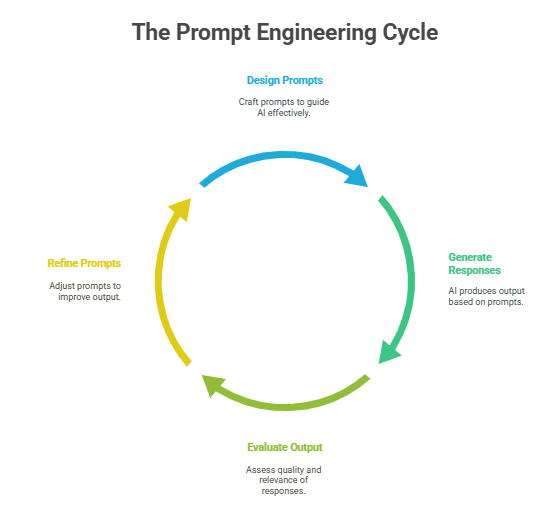
Prompt engineering is the process of structuring or crafting an instruction in order to produce the best possible output from a generative artificial intelligence (AI) model. This is an art and science of asking effective questions to AI chatbots to get personalized and effective outputs. The following are the key prompts to learn anything faster and in a practical manner.
- Teach me [topic] in 5 levels of difficulty, from child to expert.
- Build a study plan to master [topic] in 30 days with 1 hour per day
- Build a study plan with effective resources to master [topic] in 30 days with 2 hours per day.
- Make me a 7-day crash course on [topic] with tasks each day.
- What’s the fastest way to understand the logic behind [topic].
- Give me a visual map of the core ideas of [topic].
- Create a test with increasing difficulty levels on [topic].
- Turn [topic] into 10 flashcards with a question on each.
- Teach me [topic] using analogies related to [user’s passion].
- Simulate a 1:1 coaching session to master [topic] in 20 minutes.
- Build a Socratic conversation that helps me deeply understand [topic].
- What are 5 traps most people fall into when learning [topic].
- Create a memory palace to remember everything about [topic].
- “Push my brain to connect [topic] with other disciplines like physics or art.
- “Make me learn [subject] with precision, obsession, and vision like Tesla.”
- Explain [topic] in the simplest way possible, as if teaching a child.
- Break down complex ideas in [topic] into clear, basic steps.
- Create real-world examples to understand [topic] deeply.
- Challenge me with questions to test my grasp of [topic].
- Show me how to spot gaps in my knowledge about [subject].
- Help me re-teach [concept] to reinforce my understanding.
- Simplify [topic] with analogies that make it memorable.
- Guide me to solve problems [subject] by reasoning from first principles.
1. Passion Identification and Skill Alignment
Prompt: “Help me identify my passion and align it with a skill that can be mastered. Ask me reflective questions to uncover what excites me, what problems I want to solve, and what long-term goals I aspire to achieve. Then, suggest skills or topics that align with my answers and explain why they are a good fit.”
2. Comprehensive Learning Plan
Prompt: “Create a 30-day learning roadmap for mastering [topic/skill]. Break it into weekly themes, daily objectives, and specific tasks. Include a balance of theory, practice, and reflection. Recommend free online resources, tools, and exercises I can use each day.”
3. Simulated Expert Roleplay
Prompt: “Roleplay as a world-class expert in [topic/skill]. Teach me the fundamentals, intermediate techniques, and advanced strategies as if you were coaching a beginner to mastery. Answer my questions in detail, provide examples, and suggest challenges I should attempt to deepen my understanding.”
4. Curate Free Resource & Guide
Prompt: “Curate a list of the top 10 free resources to learn [topic/skill]. Include video tutorials, articles, podcasts, tools, and communities. For each resource, explain why it’s valuable, what level it caters to, and how I should use it effectively.”
5. Active Learning Exercise
Prompt: “Design a series of hands-on exercises to master [topic/skill]. Start with basic tasks to build foundational skills, then progress to intermediate challenges and advanced projects. For each exercise, explain what I’ll learn and how to evaluate my performance.”
6. Roleplay as a Peer Learner
Prompt: “Act as a fellow learner of [topic/skill]. Share your learning journey, including the mistakes you’ve made, insights you’ve gained, and techniques that worked best. Compare and discuss strategies to optimize learning together.”
7. Teach-Back Method for Mastery
Prompt: “Guide me in using the teach-back method to solidify my understanding of [topic/skill]. After I learn a concept, ask me to explain it to you in my own words. Provide feedback, point out gaps in my explanation, and clarify where needed.”
8. Real-Life Application and Scenarios
Prompt: “Present me with real-life scenarios or challenges where I can apply [topic/skill]. Help me analyze the problem, brainstorm solutions, and evaluate outcomes. For each scenario, explain how the skill is being utilized and its relevance.”
9. Personalized Accountability System
Prompt: “Help me create a personalized accountability system for learning [topic/skill]. Suggest methods to track my progress, set milestones, and stay motivated. Include ideas for rewards, check-ins, and community involvement to maintain momentum.”
10. Problem-Solving Roleplay
Prompt: “Act as a mentor and present me with common problems faced while mastering [topic/skill]. Encourage me to find solutions, then offer feedback on my approach. Provide alternative solutions and explain why they might work better.”
11. Reverse Engineering for Insights
Prompt: “Choose an expert-level example in [topic/skill] (e.g., a piece of art, code, performance). Break it down step by step to explain how it was created, the techniques involved, and how I can replicate similar outcomes as a beginner.”
12. Learning through Storytelling
Prompt: “Use storytelling to explain key concepts in [topic/skill]. Create relatable narratives or metaphors to make the material engaging and easier to remember. Ensure the story ties back to the practical application of the skill.”
13. Skill Validation
Prompt: “Guide me on how to validate my proficiency in [topic/skill]. Suggest tests, challenges, or mini-projects to showcase my knowledge. Provide examples of what ‘success’ looks like at beginner, intermediate, and advanced levels.”
14. Cross-Skill Integration
Prompt: “Help me integrate [topic/skill] with other areas of my life or work. Show how this skill complements or enhances other skills I already have or need to learn. Provide examples of synergy and how to maximize the value of combining these skills.”
15. Advanced Mastery
Prompt: “After I’ve grasped the basics of [topic/skill], guide me on creating an advanced learning plan. Focus on mastery through deep specialization, consistent practice, networking with experts, and staying updated with trends. Include steps for creating original contributions or innovations in the field.”
Feynman Approach
Ask me to explain key concepts from [Topic]. I will explain the concept to you. Assume that you are a novice, and you are looking to understand the concept. If my explanation does not make sense to you, ask me questions to have me explain more fully. Include “why” questions. If I give an incorrect answer, tell me that it doesn’t sound right. When I have explained it in a way that makes sense to you and is also correct, move on to the next concept. Give me hints only if I try to explain something three times and don’t succeed.