
Part of the Human-Centered Artificial Intelligence in Education (HCAIEd) series
Created: Netra Kumar Manandhar
Imagine a teacher preparing tomorrow’s lesson.
A decade ago, the technology question might have been:
Should I use PowerPoint, a simulation, an LMS quiz, or a video?
Today, the teacher can open a generative AI system and ask it to explain a difficult concept in five different ways, generate differentiated activities, simulate a historical character, provide feedback on student writing, develop assessment questions, translate material, create images, analyze misconceptions, or act as a personal tutor.
The possibilities are remarkable.
But here is the more important question:
If AI can generate almost anything, what should the teacher still design, judge, verify, and decide?
That question takes us beyond simply “using AI in education.”
It brings us to human-centered AI integration.
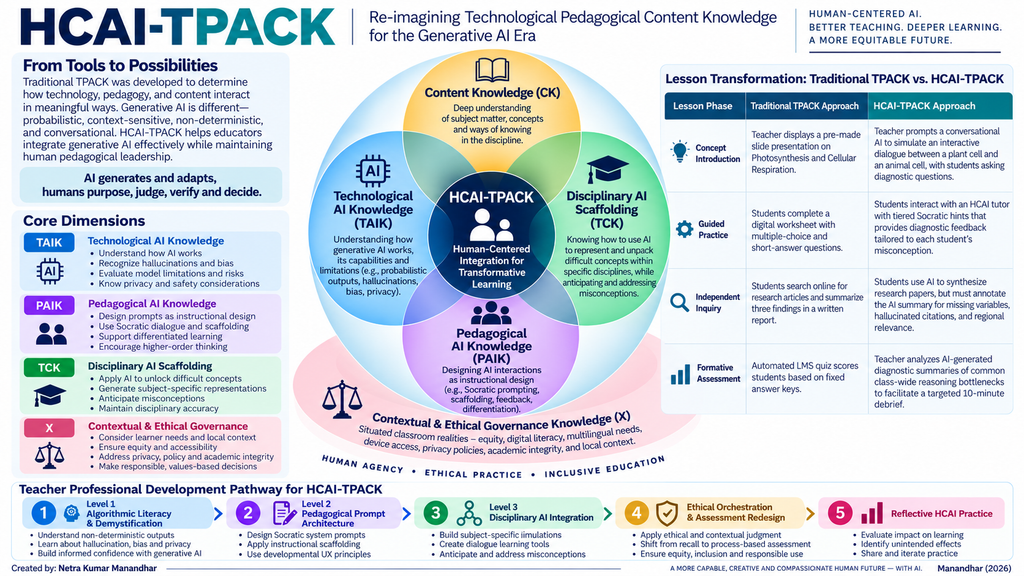
In this article, I propose HCAI-TPACK — Human-Centered Artificial Intelligence–Technological Pedagogical Content Knowledge — as a conceptual framework for thinking about the professional knowledge teachers need in the era of generative AI.
The central proposition is straightforward:
The educational value of AI does not come from what the technology can generate. It comes from how teachers pedagogically orchestrate AI while maintaining human agency, disciplinary integrity, ethical responsibility, and attention to context.
HCAI-TPACK therefore asks educators to move beyond tool use toward human-centered orchestration of AI-supported learning.
Why TPACK Still Matters — and Why Generative AI Changes the Conversation
Any attempt to rethink teacher knowledge for AI should begin by acknowledging the intellectual foundation provided by Technological Pedagogical Content Knowledge, or TPACK.
Building on Shulman’s concept of pedagogical content knowledge, Mishra and Koehler proposed TPACK as a way of understanding the complex interaction among content knowledge, pedagogical knowledge, and technological knowledge required for meaningful technology integration.
Their argument was never simply that teachers should know how to operate technology. Effective integration occurs when educators understand the relationships among the subject being taught, the way it should be taught, and the technological possibilities available for supporting learning.
This insight remains highly relevant.
However, the technological environment surrounding education has changed dramatically.
Generative AI is not simply another presentation application, learning management system, calculator, search engine, or multimedia tool. Mishra, Warr, and Islam argue that digital technologies are already protean, opaque, and unstable, but generative AI introduces especially significant generative and social characteristics. These systems can produce new content and interact conversationally with users in ways that resemble social participation.
Their outputs are also probabilistic. The same question can produce different answers. A confidently written explanation can contain an error. A model can generate an authentic-looking citation that does not exist. An explanation suitable for one learner may confuse another.
Consequently, teachers need more than operational digital competence.
They require the ability to understand AI, question it, configure it pedagogically, evaluate its outputs, place boundaries around its role, and determine when it should not be used.
That is the territory HCAI-TPACK attempts to address.
From Technology Integration to Human-Centered AI Orchestration
One way of understanding the transition is this:
| Earlier technology-integration question | HCAI-TPACK question |
|---|---|
| How can I use this technology? | Should AI be used for this learning problem? |
| Which digital tool supports the lesson? | What role should AI have in the learning process? |
| Can technology make the task more efficient? | Will AI strengthen or weaken student thinking? |
| Can the software provide feedback? | What feedback may safely be delegated to AI, and what requires human judgment? |
| Can students access the technology? | Can they access it equitably, safely, critically, and meaningfully? |
| Does the digital resource contain the required content? | Is AI-generated content epistemically reliable in this discipline? |
| How do I operate the tool? | How does the AI behave, where can it fail, and how should I respond? |
This distinction is fundamental.
HCAI-TPACK is not primarily a framework for using more AI.
It is a framework for making better educational decisions about AI.
What the Literature Is Telling Us
Several research traditions converge around the need for such a perspective.
TPACK has always been situated
TPACK itself recognizes that technology integration cannot be separated from educational context. Mishra later made contextual knowledge more explicit through the addition of XK — contextual knowledge — highlighting that teachers make technology decisions within institutional, social, organizational, and cultural environments.
Generative AI makes this contextual dimension even more important.
Consider two classrooms using the same AI system.
One may have reliable internet, individual laptops, clear institutional guidelines, digitally confident students, and English as the primary instructional language.
Another may involve shared mobile phones, intermittent connectivity, multilingual learners, uncertain privacy rules, and students encountering generative AI for the first time.
The technology may be identical.
The educational decision cannot be.
AI literacy is more than knowing how to prompt
Long and Magerko’s influential work on AI literacy emphasizes competencies needed to understand and critically interact with artificial intelligence rather than merely operate AI applications.
Similarly, Ng, Leung, Chu, and Qiao synthesized AI literacy into four broad areas: knowing and understanding AI, using AI, evaluating AI, and addressing ethical issues.
This distinction matters enormously for education.
A teacher who can write an impressive prompt but cannot identify hallucination, bias, inappropriate automation, privacy risk, or disciplinary inaccuracy cannot yet be considered pedagogically competent with AI.
Prompt fluency without critical AI literacy is insufficient.
Existing TPACK extensions already recognize AI-specific knowledge
HCAI-TPACK also emerges within an active scholarly conversation rather than in isolation.
Celik extended TPACK toward Intelligent-TPACK, demonstrating empirically that technological knowledge alone is insufficient for educational AI integration and emphasizing ethical assessment alongside technological-pedagogical knowledge.
Feldman-Maggor, Blonder, and Alexandron later examined generative AI through TPACK in chemistry education. Their analysis is particularly relevant because it argues that prompt engineering and awareness of issues such as hallucination, bias, and discrimination introduce competencies that cannot always be comfortably accommodated within conventional interpretations of TPACK.
Recent systematic reviews also show that GenAI integration requires more than access to tools. Liu and Zhong’s 2025 TPACK-oriented systematic review identifies pedagogical scaffolding as particularly important in supporting student learning with generative AI.
A systematic review of 21 higher-education implementation studies similarly concluded with a GenAI-TPACK model intended to help educators connect generative AI with meaningful pedagogical practice.
Teacher professional development is moving in the same direction. Dogan’s 2026 i-TPACK-based professional-development framework combines AI-specific TPACK domains with active learning, modelling, coaching, feedback, reflection, and explicit ethical considerations.
There are therefore already important AI-TPACK, GenAI-TPACK, Intelligent-TPACK and related AI pedagogy frameworks in the literature.
HCAI-TPACK should not be presented as though no previous scholar has attempted to extend TPACK for AI.
Its contribution lies elsewhere.
So What Is Distinctive About HCAI-TPACK?
HCAI-TPACK brings together several ideas that are often treated separately:
AI literacy + pedagogical design + disciplinary judgment + human agency + contextual governance + ethical responsibility + reflective professional practice.
Its starting assumption is that generative AI introduces a new relationship:
Teacher ↔ AI ↔ Student ↔ Knowledge
AI is no longer simply sitting in the background as a digital tool.
It can explain.
- Suggest.
- Question.
- Generate.
- Evaluate.
- Recommend.
- Simulate.
- Translate.
- Summarize.
- Respond.
And increasingly, it can take multi-step actions.
That makes the issue of who retains educational authority critically important.
Recent human-centered AI research supports this concern. A systematic review of 108 studies in human-centered learning analytics and AI in education found continued gaps in stakeholder involvement and called for greater attention to human control, safety, reliability, trustworthiness, and participation in system design.
A separate systematic review of responsible human-centered AI in education identified recurring principles including fairness and equity, privacy and security, agency and autonomy, transparency and intelligibility, and beneficence/non-maleficence.
UNESCO has moved in a similar direction. Its AI Competency Framework for Teachers organizes teacher competence around a human-centered mindset, ethics of AI, AI foundations and applications, AI pedagogy, and AI for professional learning. Crucially, the framework emphasizes the protection of teachers’ roles and enhancement of human agency.
HCAI-TPACK brings these human-centered concerns directly into the architecture of teacher knowledge.
The HCAI-TPACK Framework
At the center of HCAI-TPACK is not the AI system.
It is human-centered educational judgment.
The framework consists of interconnected domains.
1. Content Knowledge — CK
Content Knowledge remains foundational.
Teachers must know what counts as valid knowledge, evidence, reasoning, representation, explanation, and misconception within their discipline.
AI makes CK more important, not less.
Why?
Because fluent AI output can create an illusion of correctness.
A physics teacher must recognize when an AI-generated analogy violates a physical principle.
A historian must notice when AI collapses competing historical interpretations into one oversimplified narrative.
A mathematics teacher must distinguish a valid solution from an elegant-looking but logically invalid one.
An English teacher must recognize when supposedly “improved” writing has lost the learner’s intended voice.
A vocational instructor must know when AI-generated troubleshooting advice could be unsafe.
The more convincing AI becomes, the more important disciplinary expertise becomes.
2. Technological AI Knowledge — TAIK
Traditional technological knowledge is expanded into Technological AI Knowledge.
TAIK means understanding enough about AI to use it critically rather than mystically.
Teachers do not need to become machine-learning engineers. But they should understand ideas such as probabilistic generation, training data, tokens, context windows, multimodality, algorithmic bias, hallucination, model limitations, data privacy, and output variability.
They should also understand a crucial distinction:
Fluency is not certainty.
An AI system can produce a grammatically excellent answer without possessing human understanding of what it has written.
TAIK therefore changes the teacher’s relationship with AI from:
“The system gave me an answer.”
to:
“The system generated an output that I must interpret in relation to evidence, context, disciplinary knowledge, and educational purpose.”
3. Pedagogical AI Knowledge — PAIK
This may be one of the most important dimensions of HCAI-TPACK.
Pedagogical AI Knowledge concerns the teacher’s capacity to design AI interactions that support learning.
Here, prompting becomes more than a technical skill.
It becomes instructional design.
Compare these two instructions:
“Explain quadratic equations.”
and
“Act as a Socratic mathematics tutor. Do not give the solution immediately. Ask the learner one question at a time, diagnose the misconception from each response, provide a progressively stronger hint when necessary, and ask the learner to explain the final reasoning in their own words.”
The second prompt is not necessarily technologically sophisticated.
It is pedagogically sophisticated.
The teacher has embedded a theory of learning into the interaction.
PAIK therefore includes decisions about scaffolding, questioning, feedback, cognitive load, differentiation, reflection, collaboration, productive struggle, formative assessment, and metacognition.
The relevant question becomes:
What kind of thinking should the AI cause the learner to do?
not merely:
What should the AI generate?
A Critical Principle: AI Should Scaffold Cognition, Not Replace It
This principle sits at the heart of HCAI-TPACK.
Imagine that a student has to write an argumentative essay.
One use of AI is:
“Write a 1,000-word essay on climate change.”
The student receives a polished essay.
The task is completed.
But much of the intended learning may have disappeared.
Now consider a different design.
The AI is instructed to ask:
“What is your claim?”
“What evidence supports it?”
“What assumption connects this evidence with your claim?”
“What might someone who disagrees argue?”
“How would you respond?”
“Which part of your argument is currently weakest?”
Now AI is not replacing argumentation.
It is scaffolding argumentation.
The difference is not the AI system.
The difference is PAIK.
4. Disciplinary AI Scaffolding — AI-TCK
Generative AI does not have the same educational affordances across every discipline.
This creates a need for Disciplinary AI Scaffolding, conceptualized here as an AI-specific development of Technological Content Knowledge.
The question is:
What can AI meaningfully represent, simulate, explain, generate, critique, or visualize within this particular discipline — and where can it distort disciplinary meaning?
A chemistry teacher may use AI differently from a language teacher.
A mathematics educator may need AI to preserve logical reasoning and symbolic accuracy.
A history teacher may need to foreground provenance, perspective, and primary sources.
A TVET instructor must give particular attention to procedural safety and authentic workplace standards.
An arts educator may focus on originality, authorship, style, and intellectual property.
The competence therefore includes both affordance knowledge and misconception knowledge.
The teacher should know not only where AI can help but also:
Where is AI especially likely to mislead learners in my subject?
That is disciplinary AI judgment.
Examples Across the Wider Field of Education
| Discipline | Weak AI integration | HCAI-TPACK integration |
|---|---|---|
| Mathematics | AI gives students answers to equations. | AI presents three solution strategies; students compare assumptions, identify an incorrect solution, and justify the most efficient strategy. |
| Science | AI writes the laboratory report. | AI generates competing hypotheses before the experiment; students test them against observations and critique explanations afterward. |
| English/Language Education | AI rewrites the student’s essay. | AI acts as a peer reviewer, identifies patterns requiring attention, asks questions, and leaves revision decisions to the learner. |
| Social Studies/History | AI summarizes a historical event. | AI generates contrasting interpretations; students compare them with primary and scholarly sources and identify missing perspectives. |
| Teacher Education | AI produces a complete lesson plan. | AI proposes three lesson approaches; pre-service teachers critique them using learning theory, inclusion criteria, and curriculum requirements before redesigning one. |
| TVET | AI gives procedural instructions. | AI generates diagnostic workplace scenarios; learners identify faults and justify safe procedures against approved technical standards. |
| Higher Education Research | AI summarizes articles and writes the review. | AI supports literature mapping while students verify papers, compare methods, challenge synthesis, identify gaps, and document AI assistance. |
Notice what happens across these examples.
AI is present.
But human thinking remains visible.
5. Contextual and Ethical Governance Knowledge — X
HCAI-TPACK deliberately places context and governance around the other domains rather than treating ethics as an optional final checklist.
This reflects a simple reality:
A pedagogically interesting AI activity can still be educationally inappropriate.
Teachers must consider:
- student age,
- digital literacy,
- access to devices,
- language,
- culture,
- disability and accessibility,
- institutional policy,
- privacy,
- data protection,
- assessment rules,
- intellectual property,
- academic integrity,
- local curriculum,
- teacher workload,
- AI cost,
- connectivity,
- and broader social consequences.
These considerations are especially important when applying frameworks internationally.
A teaching model designed for a well-resourced university cannot simply be copied into a rural school with limited connectivity.
A chatbot optimized primarily for English may perform differently when students engage through Nepali, Arabic, indigenous languages, multilingual translanguaging, or code-switching.
An AI assessment practice acceptable in one institution may violate policy in another.
Context is therefore not background noise.
Context determines what responsible AI integration looks like.
Human Pedagogical Agency: The Organizing Principle
Rather than adding “human agency” as merely another circle in the framework, HCAI-TPACK treats Human Pedagogical Agency as an organizing principle across the entire model.
Teachers remain responsible for determining:
educational purpose → learning goals → pedagogical design → AI role → verification → intervention → assessment → accountability.
Students must likewise retain meaningful intellectual agency.
They should continue to formulate ideas, make choices, question information, create arguments, evaluate evidence, explain reasoning, reflect, and take responsibility for their learning.
This concern is increasingly visible in research. Studies of teacher agency in AI-rich environments warn that AI can both extend and constrain professional agency depending on how interaction and decision-making are structured.
The aim should therefore not be:
Human OR AI.
Nor should it be:
Human replaced BY AI.
The goal is:
Human intelligence strengthened WITH AI while meaningful human control is preserved.
The Eight Principles of HCAI-TPACK
| Principle | Meaning |
|---|---|
| 1. Human Purpose Before AI Capability | Begin with the educational problem and learning goal, not with the newest AI feature. |
| 2. Pedagogy Before Prompting | A good prompt is valuable when it embodies sound instructional reasoning. |
| 3. Augment Thinking, Do Not Automate It Away | AI should increase opportunities for reasoning, explanation, creativity, reflection, and feedback rather than remove them. |
| 4. Disciplinary Integrity Before Fluency | AI-generated content must be judged against the epistemology, evidence, standards, and misconceptions of the discipline. |
| 5. Verification Is Part of Learning | Checking AI output should itself become an educational activity rather than an invisible teacher task. |
| 6. Human Agency and Accountability Must Remain Visible | Teachers and learners should know which decisions belong to them and which processes have been delegated to AI. |
| 7. Ethics and Context Are Design Conditions | Privacy, fairness, transparency, inclusion, culture, language, accessibility, and institutional policy should shape the activity from the beginning. |
| 8. AI Integration Requires Reflection and Evidence | Teachers should evaluate whether AI actually improved learning and redesign practice when it did not. |
These principles shift the conversation from:
“How do I integrate AI?”
to:
“Under what educational conditions does AI deserve a role?”
Transforming a Lesson Through HCAI-TPACK
Consider a secondary science lesson on photosynthesis and cellular respiration.
| Lesson phase | Conventional technology-supported approach | HCAI-TPACK approach | Human-centered safeguard |
|---|---|---|---|
| Concept introduction | Teacher presents slides. | Students question an AI-mediated dialogue between a plant cell and an animal cell. | Teacher verifies scientific representations and highlights limitations of the simulation. |
| Guided practice | Students complete a digital worksheet. | AI provides tiered Socratic hints according to misconceptions. | AI is instructed not to provide the answer prematurely. |
| Collaborative learning | Groups answer the same questions. | Students compare different AI explanations and decide which is scientifically strongest. | Students must justify their judgment with disciplinary evidence. |
| Independent inquiry | Students search and summarize online material. | Students use AI for preliminary synthesis and then audit missing variables, weak claims, fabricated references, and contextual relevance. | Source verification becomes part of assessment. |
| Formative assessment | LMS automatically scores fixed answers. | Teacher reviews AI-assisted patterns of misconceptions across student responses. | Teacher—not AI—makes instructional and assessment decisions. |
| Reflection | Students review correct answers. | Students identify when AI helped their thinking, when it misled them, and what they had to verify. | Metacognition and AI literacy become explicit learning outcomes. |
This is more than substituting AI for existing technology.
It transforms the structure of learner–teacher–technology interaction.
Assessment Must Change Too
Perhaps nowhere is HCAI-TPACK more necessary than in assessment.
When generative AI can produce an essay, solve an equation, generate code, summarize a reading, design a presentation, and answer examination questions, assessing only the final product becomes increasingly problematic.
HCAI-TPACK encourages a movement toward process-visible assessment.
Instead of asking only:
“What did the student produce?”
we increasingly need to ask:
“How did the student reason?”
“What decisions did the student make?”
“What evidence was evaluated?”
“How was AI used?”
“What was accepted, rejected, or modified?”
“Can the student defend the final product?”
“What would the student do differently without AI?”
This does not require abandoning traditional assessment.
It means complementing product evaluation with evidence of reasoning, process, judgment, reflection, dialogue, iteration, and authorship.
AI Literacy Should Become Disciplinary
Another important proposition of HCAI-TPACK is that generic AI literacy is not enough.
We certainly need everyone to understand hallucination, bias, privacy, data use, verification, and responsible prompting.
But a chemistry teacher requires chemistry-AI literacy.
A mathematics teacher requires mathematics-AI literacy.
A language teacher requires language-AI literacy.
A historian requires history-AI literacy.
A vocational instructor requires occupational AI literacy.
This is because AI errors are not generic.
They occur inside disciplinary forms of knowledge.
The strongest defense against sophisticated AI misinformation may therefore be neither banning AI nor relying entirely on automated detection.
It may be developing people who possess enough disciplinary knowledge and critical AI literacy to recognize when an apparently convincing answer is wrong.
A Five-Level Professional Learning Pathway for HCAI-TPACK
HCAI-TPACK also proposes a developmental model for teacher professional development.
| Level | Professional focus | Teacher capability |
|---|---|---|
| Level 1 — Algorithmic Literacy & Demystification | Understand generative AI | Teachers understand probabilistic generation, hallucination, bias, privacy, limitations, and basic human–AI interaction. |
| Level 2 — Pedagogical Prompt Architecture | Design learning interactions | Teachers create Socratic prompting, scaffolding, differentiation, feedback structures, and cognitive constraints. |
| Level 3 — Disciplinary AI Integration | Integrate AI within subject knowledge | Teachers build subject-specific activities and recognize discipline-specific affordances and misconceptions. |
| Level 4 — Ethical Orchestration & Assessment Redesign | Govern AI-supported learning | Teachers redesign assessment, address equity/privacy/integrity, and determine appropriate human–AI roles. |
| Level 5 — Reflective HCAI Practice | Evaluate and improve | Teachers collect evidence of learning, identify over-reliance or unintended effects, share practice, and iteratively redesign AI-supported pedagogy. |
This progression deliberately moves away from short workshops built around:
“Here are 20 AI tools teachers should know.”
Teacher professional development should instead begin with:
understanding → pedagogical design → disciplinary integration → ethical orchestration → reflective improvement.
UNESCO’s teacher AI competency framework similarly emphasizes progression across human-centered mindset, ethics, AI foundations, AI pedagogy, and professional learning, reinforcing the importance of developmental rather than purely tool-oriented teacher preparation.
What HCAI-TPACK Is Not
HCAI-TPACK is not intended to replace TPACK.
It builds upon it.
It does not suggest that pedagogy, content knowledge, or pedagogical content knowledge have suddenly become obsolete.
Quite the opposite.
The rise of generative AI makes professional pedagogical and disciplinary knowledge even more important.
Nor is HCAI-TPACK intended to suggest that every lesson should contain AI.
Sometimes the most human-centered AI decision is:
Do not use AI here.
- A face-to-face discussion may be better.
- A physical experiment may be better.
- Handwriting may be better.
- Peer dialogue may be better.
- Independent struggle may be better.
- Reading the original text may be better.
- Talking to the teacher may be better.
Human-centered AI education includes the professional capacity to recognize when technological non-use is pedagogically superior to technological use.
How HCAI-TPACK Relates to Existing AI-TPACK Frameworks
Scholarly positioning matters.
Existing work has already extended TPACK toward AI-specific technological knowledge, pedagogical knowledge, content integration, ethics, and human–AI collaboration. Celik’s Intelligent-TPACK, emerging GenAI-TPACK models, recent professional-development frameworks, and Chiu’s corrected Human-Centric Artificial Intelligence Pedagogy (HCAP) framework all contribute to this rapidly evolving research landscape.
The proposed HCAI-TPACK framework therefore does not claim that it is the first attempt to rethink TPACK for artificial intelligence.
Its proposed distinctive contribution is the explicit integration of:
human pedagogical agency at the center;
AI-specific technological understanding;
pedagogical prompt architecture;
disciplinary AI scaffolding;
contextual and ethical governance as an encompassing condition;
lesson and assessment transformation; and
a developmental pathway toward reflective HCAI practice.
In other words, the framework is intended to move the conversation from AI competence toward human-centered AI orchestration.
That distinction is important.
A Practical HCAI-TPACK Decision Test
Before using generative AI in a learning activity, a teacher can ask five questions:
Purpose
What learning problem am I trying to solve?
Cognition
What must the learner still think, explain, create, evaluate, or decide?
Discipline
What could AI misunderstand, oversimplify, or misrepresent in this subject?
Human Agency
Who remains responsible for judgment and decision-making?
Context and Ethics
Is this use equitable, transparent, private, accessible, safe, and appropriate for this educational context?
If we cannot answer these questions, we may not yet be ready to integrate the AI.
From AI as Answer Machine to AI as Cognitive Partner
The deepest transformation proposed by HCAI-TPACK concerns how we conceptualize the role of AI.
Poorly designed educational AI often becomes an answer machine.
Well-designed educational AI can become a cognitive partner.
It can challenge.
- Question.
- Generate alternatives.
- Expose contradictions.
- Simulate perspectives.
- Offer formative feedback.
- Help visualize the invisible.
- Provide multiple representations.
- Support rehearsal.
- Encourage reflection.
But the partnership works only if the human remains capable of questioning the partner.
That requires AI literacy.
It requires disciplinary expertise.
It requires pedagogy.
And it requires agency.
A Research Agenda for HCAI-TPACK
For HCAI-TPACK to develop from a conceptual proposal into a robust academic framework, it must eventually be subjected to empirical investigation.
Several propositions are particularly suitable for future research.
First, TAIK alone should not strongly predict high-quality AI-supported teaching unless it interacts with pedagogical AI knowledge. Knowing more about AI may improve technological fluency without necessarily improving teaching.
Second, PAIK may mediate the relationship between AI competence and educational outcomes. In other words, what teachers know about AI becomes educationally useful largely through the pedagogical interactions they design.
Third, disciplinary AI scaffolding should influence the accuracy and epistemic quality of AI-supported learning, particularly in domains where plausible misconceptions are common.
Fourth, contextual and ethical governance may moderate successful AI implementation. The same intervention may produce different outcomes depending on access, language, institutional policy, student preparedness, privacy conditions, and culture.
Fifth, human agency may represent a critical mechanism connecting AI integration with deeper learning. Activities requiring learners to evaluate, explain, revise, and contest AI output may produce different outcomes from activities based primarily on AI-generated completion.
Finally, integrated HCAI-TPACK competence may prove more predictive of meaningful AI integration than measures based only on frequency of AI use or self-reported technical confidence.
Such propositions can eventually support instrument development, Delphi validation, structural models, classroom observation protocols, intervention studies, teacher professional-development research, and cross-cultural validation.
At this stage, therefore, HCAI-TPACK should be understood as a proposed conceptual framework and research agenda whose components and relationships require empirical examination.
That is not a weakness.
It is the next stage of framework development.
The Larger Educational Question
Generative AI is moving astonishingly quickly.
Education cannot respond by chasing every new feature.
Nor can we assume that because AI can perform an educational task, delegating that task to AI is automatically beneficial.
The real question is not:
What can AI do?
The educational question is:
What should humans continue to learn, practice, experience, struggle with, create, judge, and understand — and how can AI expand those opportunities rather than remove them?
That is the question HCAI-TPACK is designed to keep visible.
Technology matters.
Pedagogy matters.
Content matters.
AI literacy matters.
Ethics matters.
Context matters.
But they ultimately serve something larger:
human learning and human development.
The HCAI-TPACK Proposition
The framework can therefore be summarized in one sentence:
HCAI-TPACK is the integrated professional knowledge through which educators understand, design, discipline, contextualize, govern, and critically evaluate generative AI so that it augments human learning while preserving pedagogical agency, disciplinary integrity, ethical responsibility, and human accountability.
Or even more simply:
- Understand AI.
- Design with AI.
- Teach the discipline with AI.
- Critically govern AI.
- Keep humans in educational control.
The future of education should not be built around making learners more dependent on increasingly intelligent machines.
It should be built around developing more capable, reflective, creative, ethical, and intellectually independent human beings who know how to work intelligently with those machines.
That, ultimately, is the purpose of HCAI-TPACK.
References
Alfredo, R., Echeverria, V., Jin, Y., Yan, L., Swiecki, Z., Gašević, D., & Martinez-Maldonado, R. (2024). Human-centred learning analytics and AI in education: A systematic literature review. Computers and Education: Artificial Intelligence, 6, 100215. doi:10.1016/j.caeai.2024.100215.
Belkina, M., Daniel, S., Nikolic, S., Haque, R., Lyden, S., Neal, P., Grundy, S., & Hassan, G. M. (2025). Implementing generative AI (GenAI) in higher education: A systematic review of case studies. Computers and Education: Artificial Intelligence, 8, 100407. doi:10.1016/j.caeai.2025.100407.
Celik, I. (2023). Towards Intelligent-TPACK: An empirical study on teachers’ professional knowledge to ethically integrate artificial intelligence (AI)-based tools into education. Computers in Human Behavior, 138, 107468. doi:10.1016/j.chb.2022.107468.
Dogan, S. (2026). Designing effective AI professional development: A framework grounded in intelligent-TPACK. Computers and Education Open, 10, 100337. doi:10.1016/j.caeo.2026.100337.
Feldman-Maggor, Y., Blonder, R., & Alexandron, G. (2025). Perspectives of generative AI in chemistry education within the TPACK framework. Journal of Science Education and Technology, 34(1), 1–12. doi:10.1007/s10956-024-10147-3.
Fu, Y., & Weng, Z. (2024). Navigating the ethical terrain of AI in education: A systematic review on framing responsible human-centered AI practices. Computers and Education: Artificial Intelligence, 7, 100306. doi:10.1016/j.caeai.2024.100306.
Kasneci, E., et al. (2023). ChatGPT for good? On opportunities and challenges of large language models for education. Learning and Individual Differences, 103, 102274. doi:10.1016/j.lindif.2023.102274.
Long, D., & Magerko, B. (2020). What is AI literacy? Competencies and design considerations. Proceedings of the 2020 CHI Conference on Human Factors in Computing Systems, 1–16. doi:10.1145/3313831.3376727.
Liu, X., & Zhong, B. (2025). Integrating generative artificial intelligence into student learning: A systematic review from a TPACK perspective. Educational Research Review, 49, 100741. doi:10.1016/j.edurev.2025.100741.
Miao, F., & Cukurova, M. (2024). AI competency framework for teachers. UNESCO.
Miao, F., & Holmes, W. (2023). Guidance for generative AI in education and research. UNESCO.
Mishra, P. (2019). Considering contextual knowledge: The TPACK diagram gets an upgrade. Journal of Digital Learning in Teacher Education, 35(2), 76–78. doi:10.1080/21532974.2019.1588611.
Mishra, P., & Koehler, M. J. (2006). Technological pedagogical content knowledge: A framework for teacher knowledge. Teachers College Record, 108(6), 1017–1054. doi:10.1111/j.1467-9620.2006.00684.x.
Mishra, P., Warr, M., & Islam, R. (2023). TPACK in the age of ChatGPT and generative AI. Journal of Digital Learning in Teacher Education, 39(4), 235–251. doi:10.1080/21532974.2023.2247480.
Ng, D. T. K., Leung, J. K. L., Chu, K. W. S., & Qiao, M. S. (2021). AI literacy: Definition, teaching, evaluation and ethical issues. Proceedings of the Association for Information Science and Technology, 58(1), 504–509. doi:10.1002/pra2.487.
Shulman, L. S. (1986). Those who understand: Knowledge growth in teaching. Educational Researcher, 15(2), 4–14.
Tlili, A., Shehata, B., Adarkwah, M. A., et al. (2023). What if the devil is my guardian angel: ChatGPT as a case study of using chatbots in education. Smart Learning Environments, 10, 15. doi:10.1186/s40561-023-00237-x.