

The End of an Era: Why Traditional Bloom’s Taxonomy No Longer Serves Us
Picture this: A student sits down to write an essay on climate change. Within minutes, they’ve generated a comprehensive outline, gathered relevant statistics, and even produced a first draft—all with the help of AI. Traditional Bloom’s Taxonomy would classify this as “creating,” the highest level of cognitive achievement. But have they really engaged in higher-order thinking?
This scenario, playing out in classrooms worldwide, reveals a fundamental problem: The cognitive framework that has guided education for nearly 70 years is no longer fit for purpose in an AI-driven world.
Benjamin Bloom’s taxonomy, developed in the 1950s, served us well when information was scarce and cognitive tasks were purely human endeavors. But today, when artificial intelligence can remember vast amounts of information, understand complex concepts, and even create original content, we need to fundamentally rethink what it means to think, learn, and create.
The Challenge: When AI Outperforms Humans at “Higher-Order” Tasks
Recent research from the Times Higher Education highlights a critical issue: Large language models like ChatGPT and Gemini use Bloom’s taxonomy as one of their primary training frameworks for defining critical thinking. This creates a paradox where AI systems are designed to excel at the very cognitive skills we’re trying to teach students.
Consider these troubling examples:
- AI can “remember” infinite amounts of information with perfect accuracy
- AI can “understand” complex concepts and explain them in multiple ways
- AI can “apply” knowledge to solve novel problems
- AI can “analyze” patterns in data at a superhuman scale
- AI can “evaluate” arguments and make reasoned judgments
- AI can “create” original content, from poetry to code
If AI can perform all these tasks—often better than humans—what’s left for human cognition? More importantly, how do we prepare students for a world where their thinking partners are artificial intelligences?
The Solution: AI-Powered Bloom’s Taxonomy
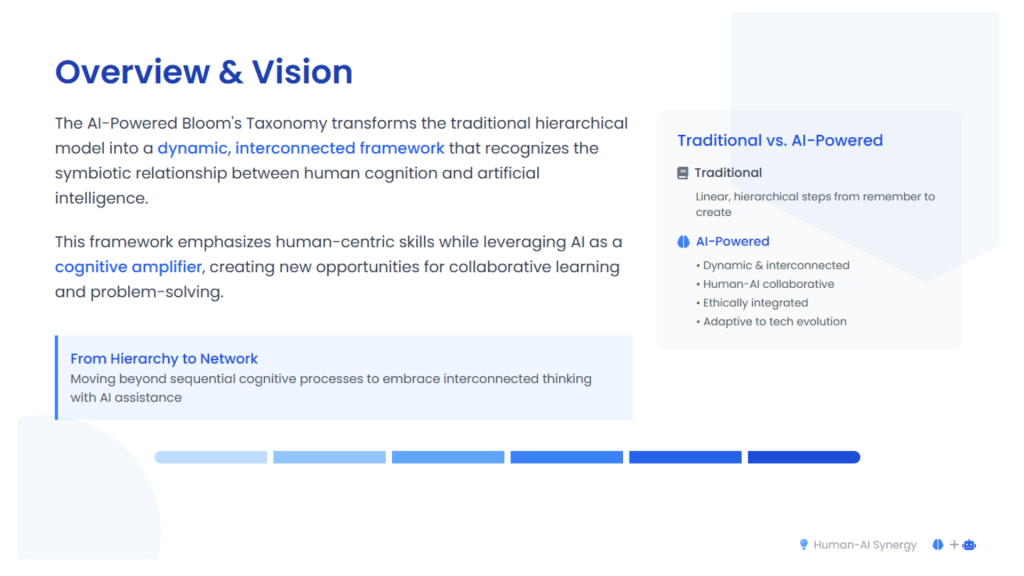
After extensive research and analysis of current educational challenges, I’ve developed a revolutionary framework: The AI-Powered Bloom’s Taxonomy. This isn’t just a minor update to the original model—it’s a complete reimagining of how we think about cognition in the age of artificial intelligence.
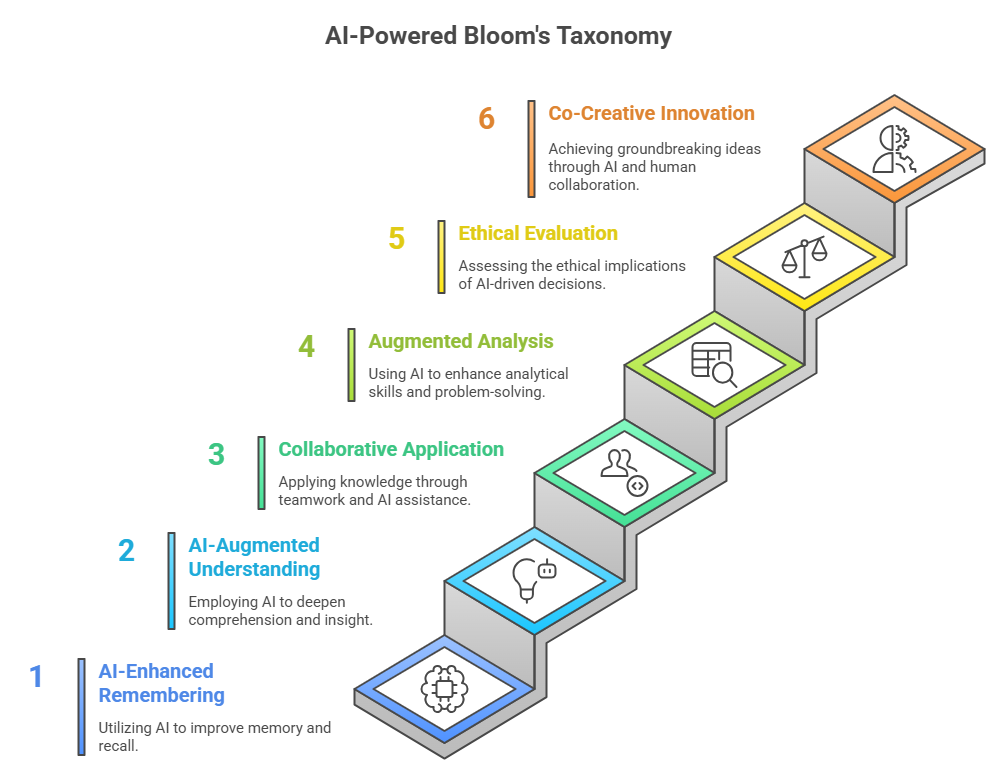
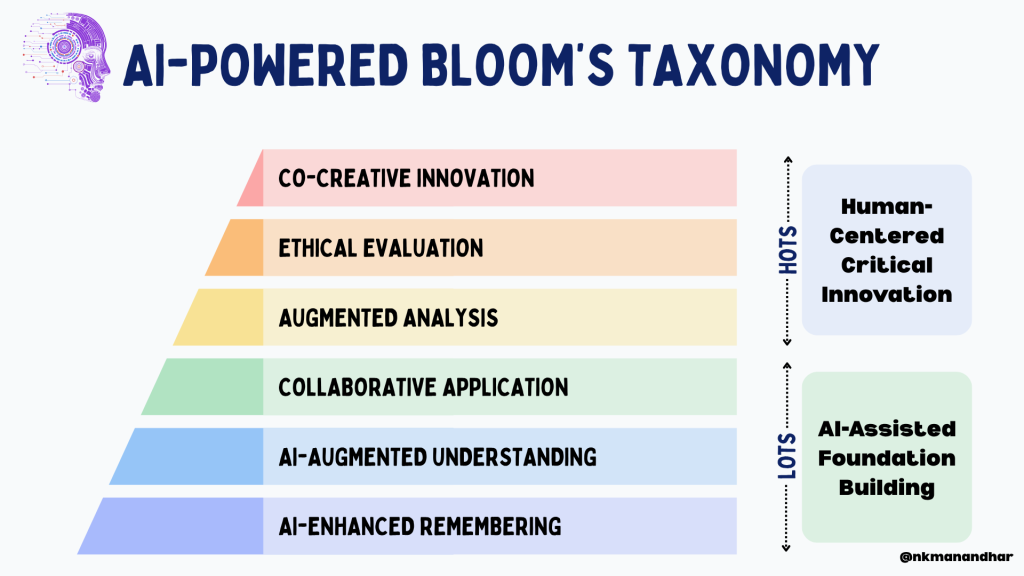
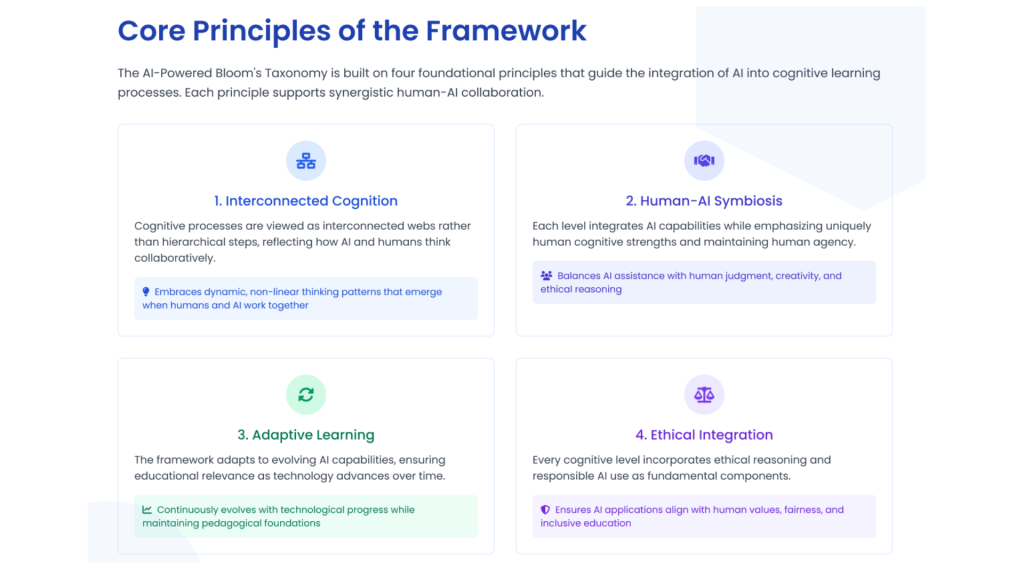
Core Principles of the New Framework
1. From Hierarchy to Interconnection Traditional Bloom’s assumes cognitive skills build sequentially, like climbing a ladder. The AI-Powered framework recognizes that thinking skills are interconnected webs, reflecting how humans and AI actually collaborate.
2. Human-AI Symbiosis Rather than viewing AI as a threat to human cognition, this framework positions AI as a cognitive amplifier that enhances human capabilities while highlighting uniquely human strengths.
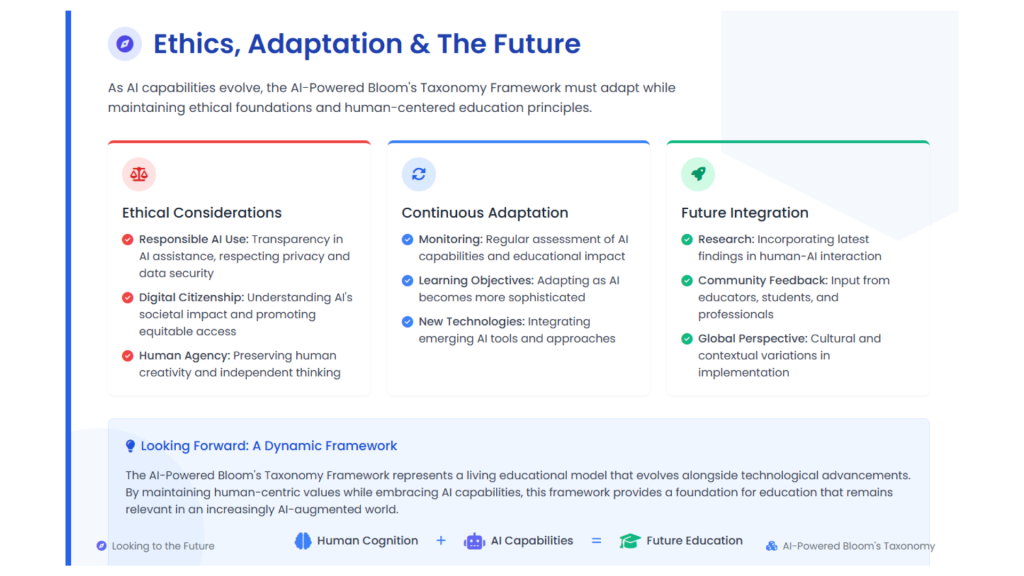
3. Ethical Integration Every level of the framework incorporates ethical reasoning and responsible AI use, preparing students to navigate the complex moral landscape of AI-enhanced decision-making.
4. Adaptive Evolution The framework is designed to evolve with advancing AI capabilities, ensuring educational relevance as technology continues to develop.
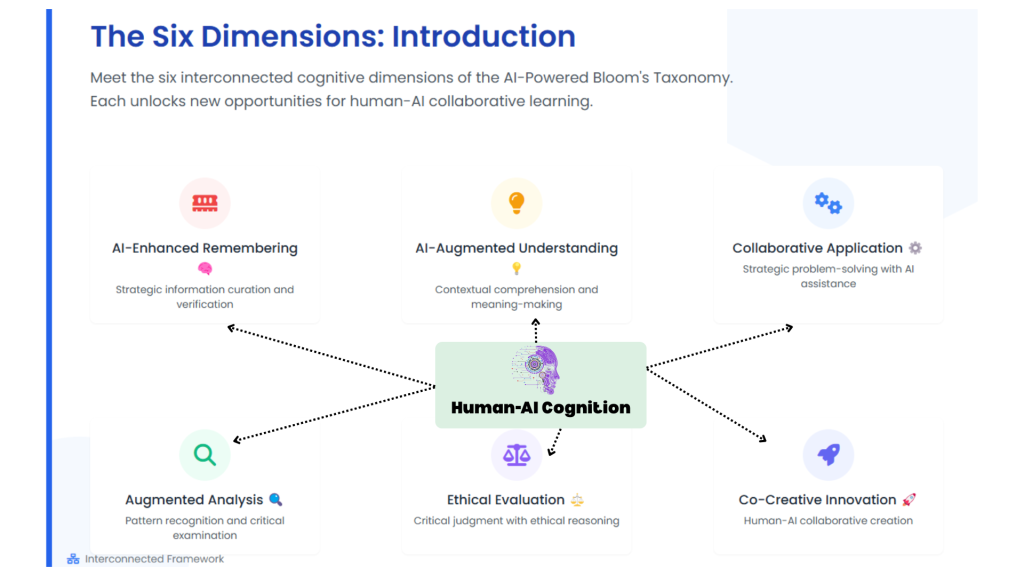
The Six Dimensions of AI-Powered Cognition
Lower Order: “AI-Assisted Foundation Building”
1. AI-Enhanced Remembering
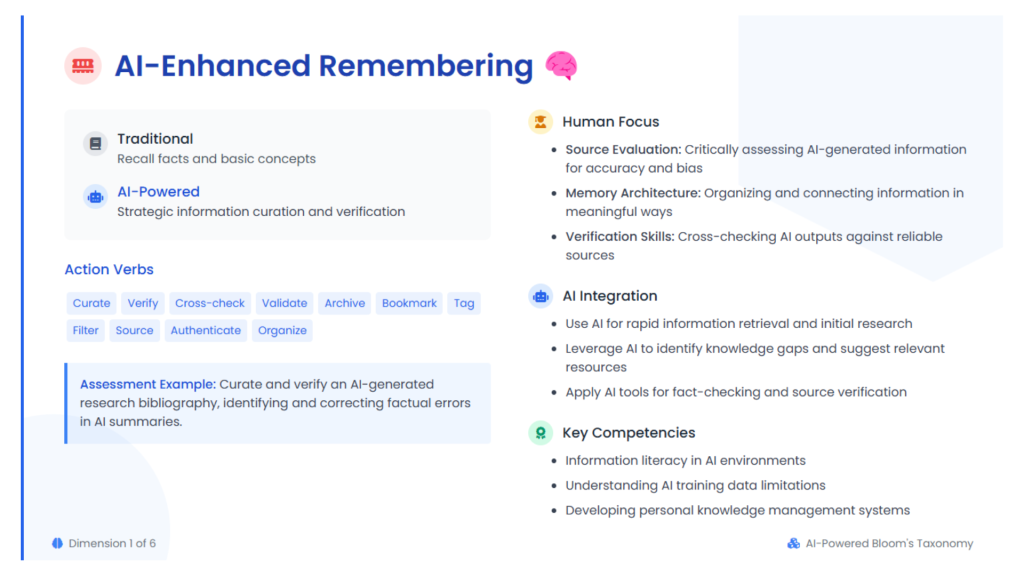
Action Verbs: Curate, Verify, Cross-check, Validate, Archive, Authenticate, Trace, Corroborate
The Traditional View: Students memorize facts and basic concepts.
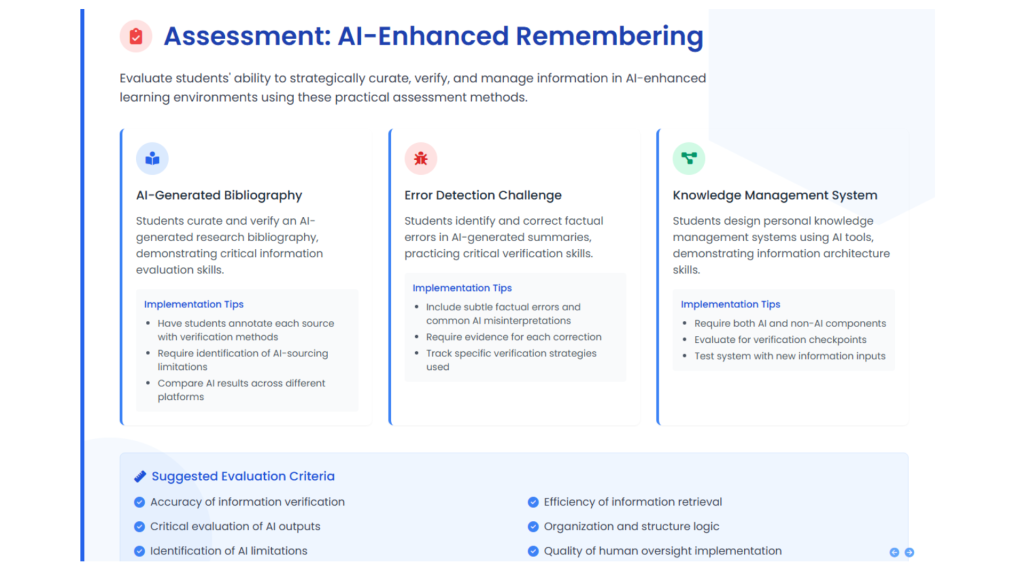
The AI-Powered Reality: Students become strategic information curators, learning to verify AI-generated content, identify reliable sources, and build personal knowledge management systems.
Real-World Application: Instead of memorizing historical dates, students learn to curate and verify AI-generated historical timelines, cross-checking multiple sources and understanding the limitations of AI training data.
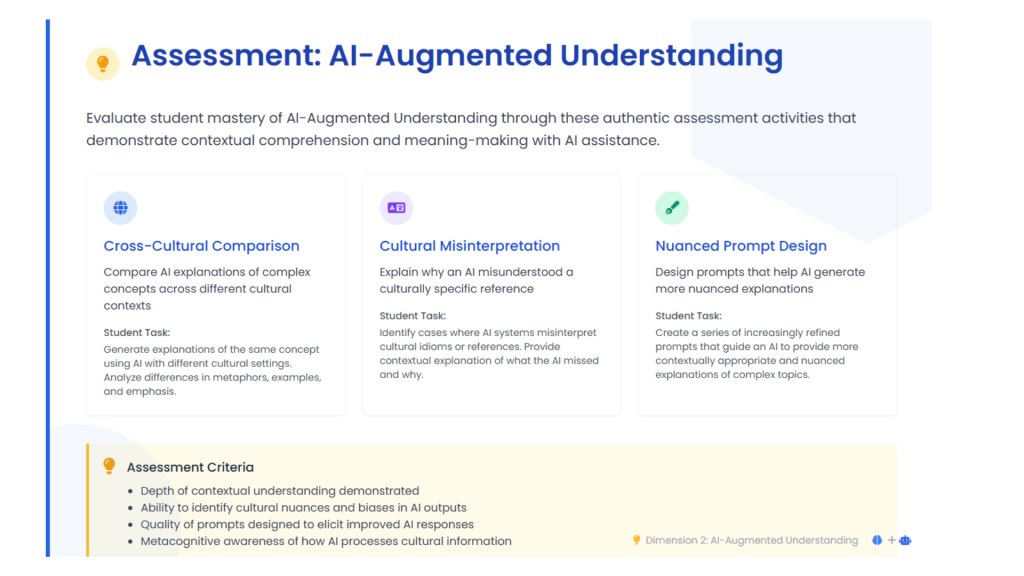
2. AI-Augmented Understanding
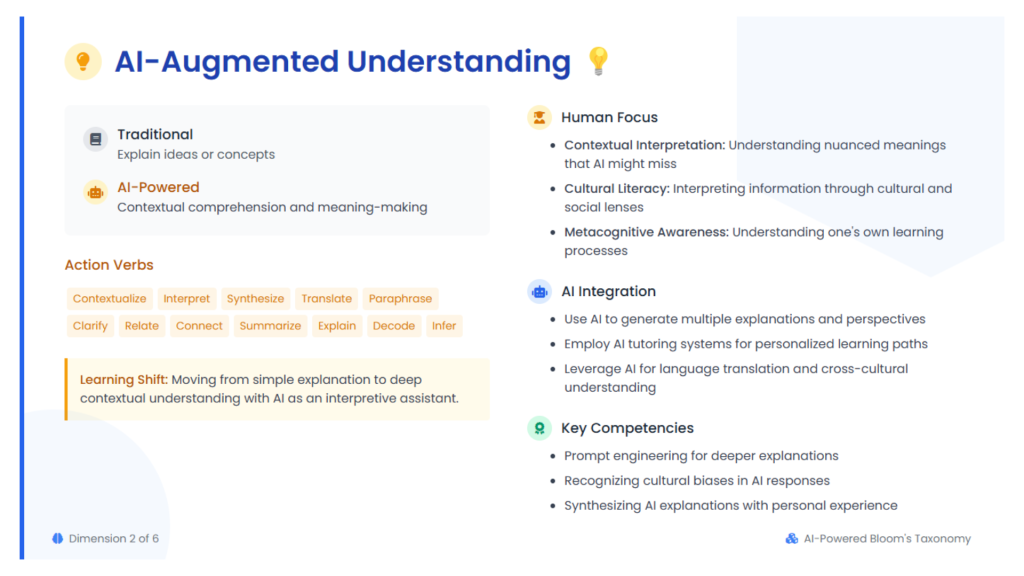
Action Verbs: Contextualize, Interpret, Synthesize, Translate, Humanize, Personalize, Reframe
The Traditional View: Students explain ideas or concepts in their own words.
The AI-Powered Reality: Students develop contextual interpretation skills, understanding cultural nuances that AI might miss, and synthesizing AI explanations with personal experience and cultural knowledge.
Real-World Application: Students use AI to generate multiple explanations of quantum physics, then interpret these explanations through different cultural and philosophical lenses, identifying where human context adds meaning.
3. Collaborative Application
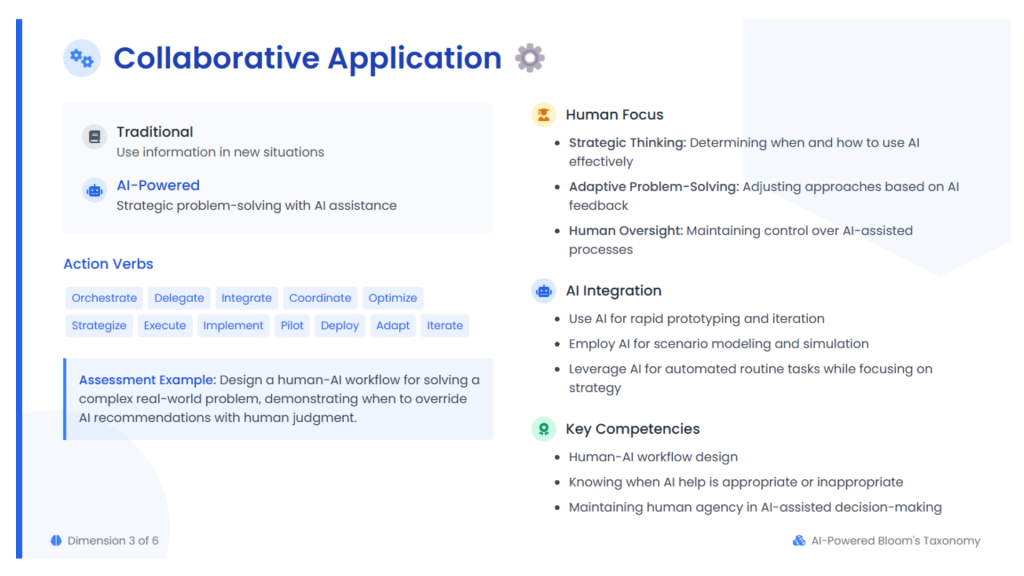
Action Verbs: Orchestrate, Delegate, Integrate, Coordinate, Optimize, Strategize, Execute
The Traditional View: Students use information in new situations independently.
The AI-Powered Reality: Students become strategic orchestrators, determining when and how to use AI effectively while maintaining human oversight and decision-making authority.
Real-World Application: Students design a community sustainability project, strategically delegating research and modeling tasks to AI while maintaining human control over stakeholder engagement and ethical considerations.
Higher Order: “Human-Centered Critical Innovation”
4. Augmented Analysis
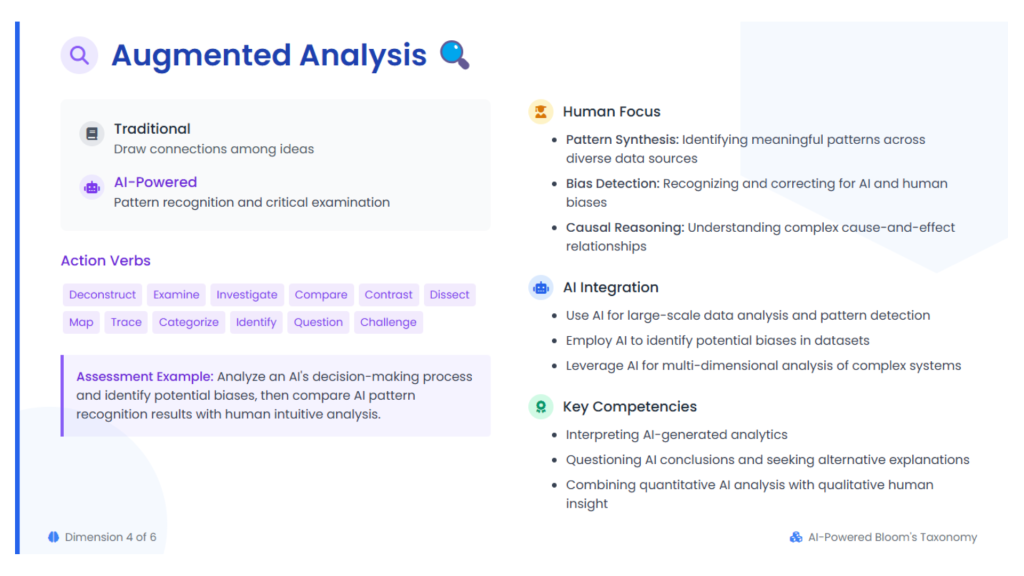
Action Verbs: Deconstruct, Examine, Investigate, Compare, Contrast, Question, Challenge, Probe
The Traditional View: Students draw connections among ideas independently.
The AI-Powered Reality: Students become critical investigators, examining AI-generated analysis for bias, questioning AI conclusions, and combining quantitative AI insights with qualitative human understanding.
Real-World Application: Students use AI to analyze large datasets about social media usage, then critically examine the AI’s conclusions, identify potential biases, and provide human interpretation of the social and psychological implications.
5. Ethical Evaluation
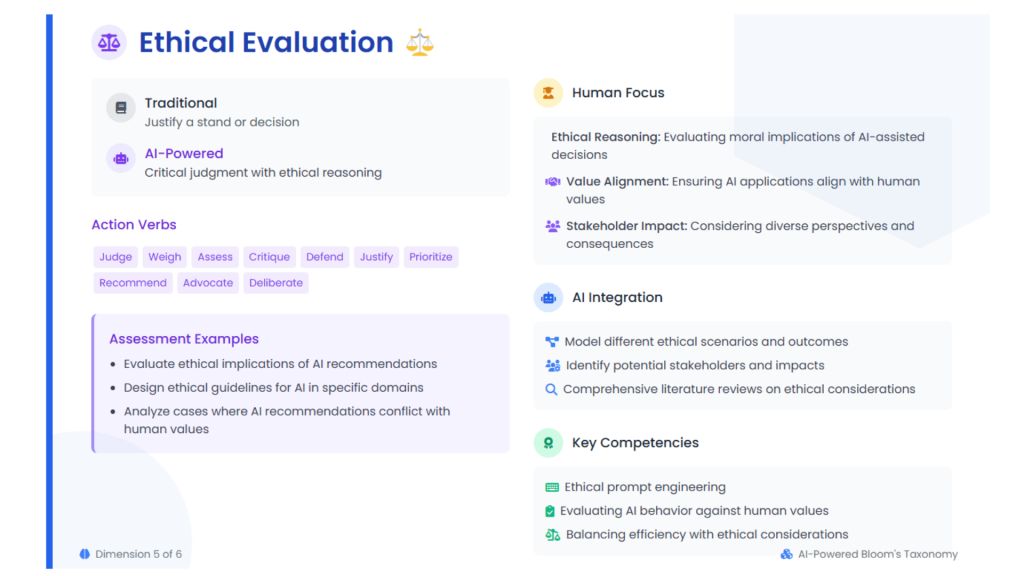
Action Verbs: Judge, Weigh, Assess, Critique, Defend, Justify, Advocate, Deliberate
The Traditional View: Students justify positions or decisions based on evidence.
The AI-Powered Reality: Students develop sophisticated ethical reasoning skills, evaluating the moral implications of AI-assisted decisions and ensuring AI applications align with human values.
Real-World Application: Students evaluate different AI hiring algorithms, considering fairness, bias, and stakeholder impact, then advocate for ethical implementation guidelines that balance efficiency with human dignity.
6. Co-Creative Innovation
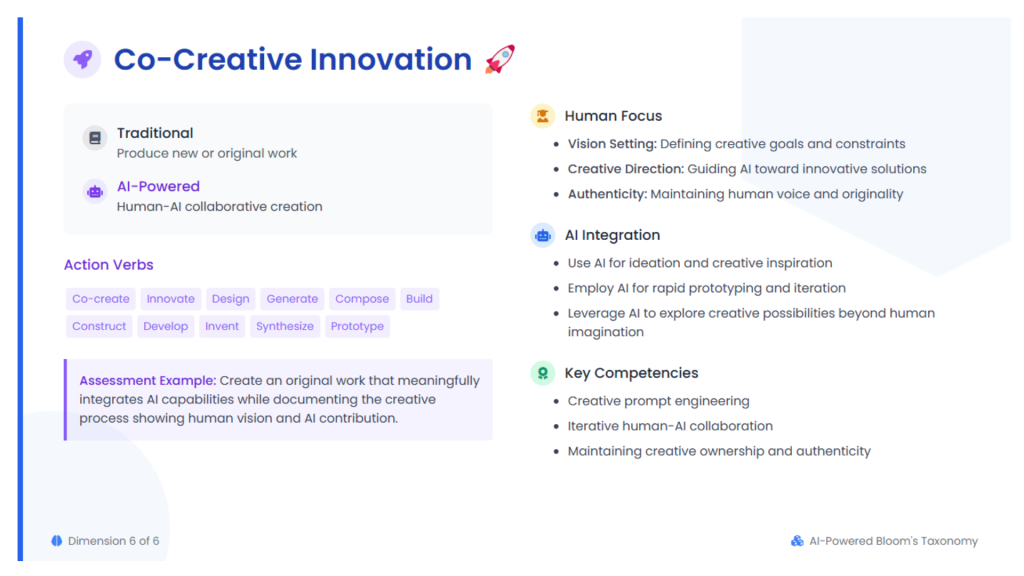
Action Verbs: Co-create, Innovate, Design, Generate, Compose, Invent, Originate, Pioneer
The Traditional View: Students produce new or original work independently.
The AI-Powered Reality: Students become creative directors, setting vision and maintaining authenticity while collaborating with AI to explore possibilities beyond human imagination alone.
Real-World Application: Students co-create with AI to design innovative solutions for urban planning challenges, maintaining human vision for livability and community while leveraging AI’s computational power for optimization and modeling.
Practical Implementation: From Theory to Classroom
For Educators: Transforming Your Teaching Practice
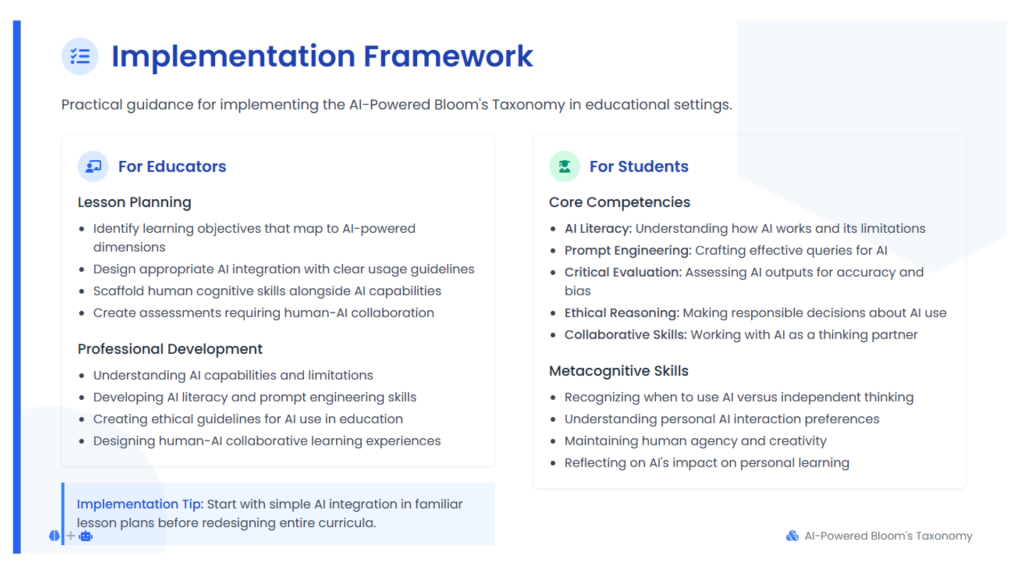
Lesson Planning Revolution Instead of asking “What should students know?” ask “How can students strategically partner with AI to achieve deeper understanding?” This shift transforms every lesson from information delivery to collaborative intelligence development.
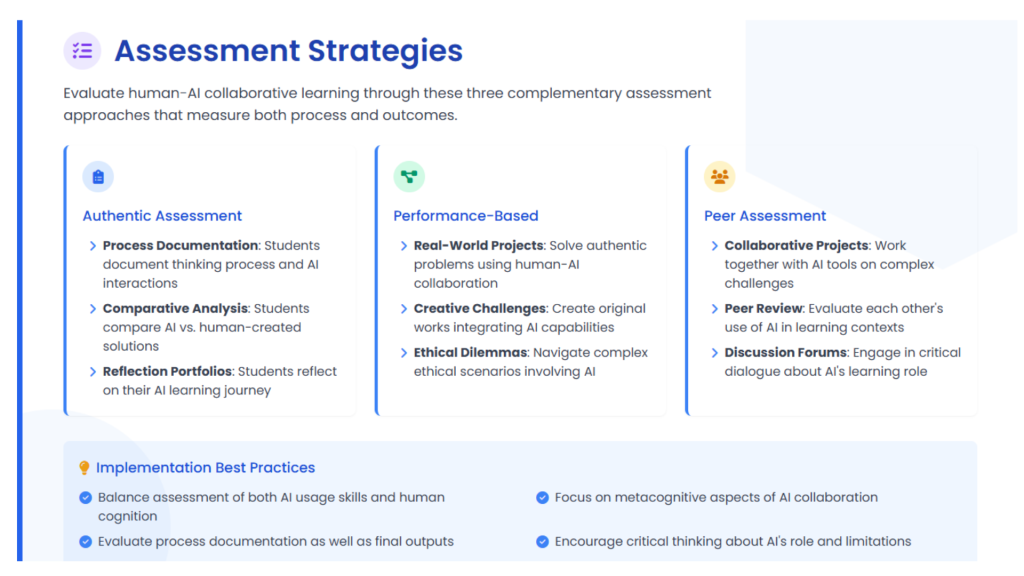
Assessment Reimagined Traditional assessments that can be easily completed by AI become obsolete. New assessments focus on:
- Process documentation: How did students work with AI?
- Critical evaluation: How did students verify and interpret AI outputs?
- Ethical reasoning: How did students navigate moral complexities?
- Creative collaboration: How did students maintain authenticity while leveraging AI?
Professional Development Priorities Educators need new competencies:
- Understanding AI capabilities and limitations
- Developing prompt engineering skills
- Creating ethical guidelines for AI use
- Designing human-AI collaborative learning experiences
For Students: Developing 21st Century Cognitive Skills
Core Competencies for the AI Age
- AI Literacy: Understanding how AI works and its limitations
- Prompt Engineering: Crafting effective queries and instructions
- Critical Evaluation: Assessing AI outputs for accuracy and bias
- Ethical Reasoning: Making responsible decisions about AI use
- Collaborative Intelligence: Working effectively with AI as a thinking partner
Metacognitive Skills Students must develop awareness of:
- When to use AI versus when to think independently
- How their personal biases interact with AI biases
- The impact of AI on their learning and creativity
- Strategies for maintaining human agency and authenticity
Real-World Case Studies: The Framework in Action
Case Study 1: High School History Class
Traditional Approach: Students write research papers on World War II, citing multiple sources.
AI-Powered Approach: Students use AI to generate initial research and timelines, then verify information across sources, analyze AI-generated content for historical bias, evaluate different historical perspectives, and co-create multimedia presentations that combine AI efficiency with human storytelling.
Outcome: Students develop sophisticated information literacy skills, understand the complexity of historical interpretation, and create more engaging, comprehensive projects.
Case Study 2: University Engineering Program
Traditional Approach: Students design bridges using established engineering principles and manual calculations.
AI-Powered Approach: Students collaborate with AI for complex calculations and modeling while maintaining human oversight for safety considerations, ethical implications, and environmental impact. They learn to validate AI recommendations and make final decisions based on human judgment.
Outcome: Students become more efficient problem-solvers while developing critical thinking skills about when to trust or question AI recommendations.
Case Study 3: Elementary Science Education
Traditional Approach: Students memorize the water cycle and create basic diagrams.
AI-Powered Approach: Students use AI to explore complex climate models, then interpret these models for their local environment, consider the human impact of climate change, and design community solutions that balance AI optimization with human values.
Outcome: Students develop systems thinking skills and understand the intersection of science, technology, and human society.
Addressing Common Concerns
“Won’t Students Become Dependent on AI?”
The framework specifically addresses this concern by emphasizing human oversight, critical evaluation, and independent decision-making at every level. Students learn when to use AI, when to think independently, and how to maintain human agency.
“How Do We Assess Authentic Learning?”
The framework provides specific assessment strategies that require human-AI collaboration, critical thinking, and ethical reasoning—skills that cannot be easily replicated by AI alone.
“What About Academic Integrity?”
Rather than prohibiting AI use, the framework teaches transparent, ethical AI collaboration. Students learn to document their AI interactions, understand intellectual property implications, and maintain academic honesty in AI-enhanced work.
“Is This Framework Future-Proof?”
The framework is designed to evolve with advancing AI capabilities. Its core principles of human-AI collaboration, ethical reasoning, and critical evaluation remain relevant regardless of technological advancement.
The Ethical Imperative: Why This Matters Now
We’re not just updating an educational framework—we’re preparing students for a future where their success depends on their ability to collaborate effectively with artificial intelligence while maintaining human values, creativity, and ethical reasoning.
The stakes are high. Students who learn to work with AI strategically and ethically will thrive in the future economy. Those who don’t will be left behind. But more importantly, we have a responsibility to ensure that the next generation can guide AI development in directions that benefit humanity.

