

Summary
This report presents a comprehensive analysis of the emerging field of Agentic AI and its applications in mathematics education. Agentic AI—characterized by systems that can reason, adapt, and act autonomously—reshapes traditional mathematics teaching and learning approaches. Through an extensive review of academic research, case studies, and current implementations, this report explores how these AI systems are being deployed to create personalized learning experiences, support diverse learning needs, and potentially transform educational outcomes in mathematics.
The findings reveal both promising opportunities and significant challenges. While agentic AI demonstrates considerable potential for enhancing mathematics education through personalized instruction, real-time feedback, and innovative teaching paradigms, important considerations around ethical implementation, equitable access, and the balance between technological assistance and human interaction remain crucial areas for development.
1. Introduction to Agentic AI in Educational Contexts
1.1 Defining Agentic AI
Agentic AI refers to artificial intelligence systems designed to operate with a degree of autonomy, making decisions and taking actions to achieve specific goals with minimal human intervention (Datacamp). Unlike traditional reactive AI systems that simply respond to specific inputs, agentic AI possesses several defining characteristics that make it particularly valuable in educational settings:
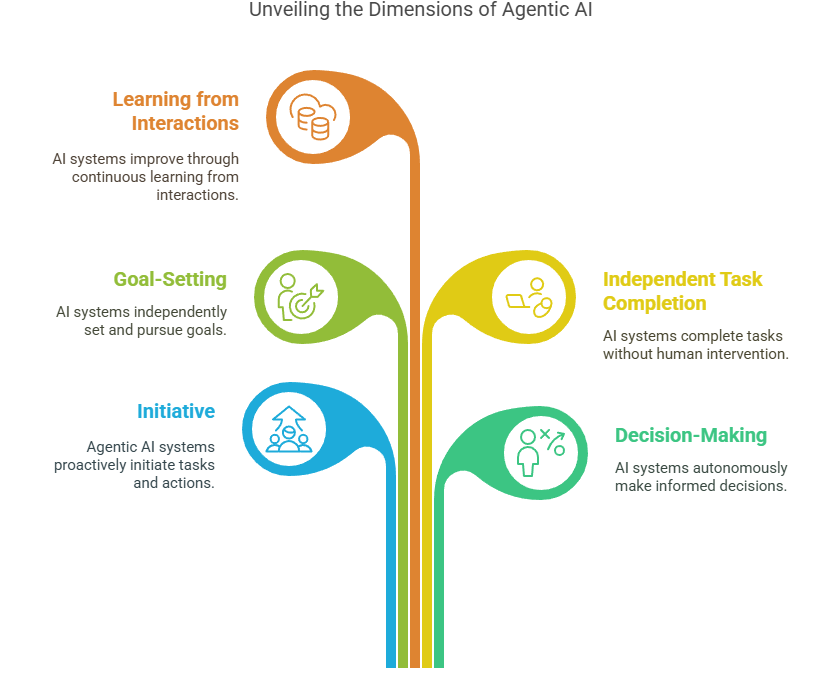
- Autonomy: The ability to operate independently with minimal human oversight
- Decision-making capability: Analyzing variables to make informed educational decisions
- Proactivity: Anticipating learning needs and taking preventive actions
- Personalization at scale: Using data to deliver customized learning paths
- Contextual understanding: Interpreting and responding to natural language and behavioral cues
- Emotional intelligence: Detecting and addressing emotional states
- Collaborative support: Facilitating group activities and coordinated learning (MeraTutor.AI)
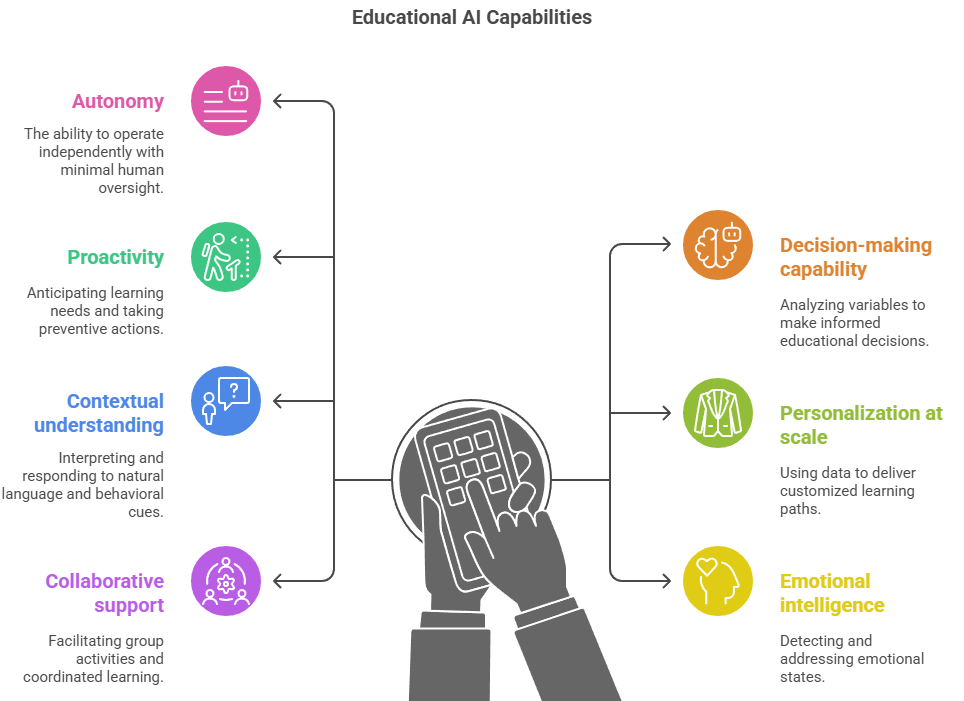
In mathematics education specifically, these capabilities enable systems to adapt to individual learning needs, provide targeted feedback, and create personalized learning experiences that address the unique challenges students face when learning mathematical concepts.
1.2 Evolution from Traditional AI to Agentic AI in Education
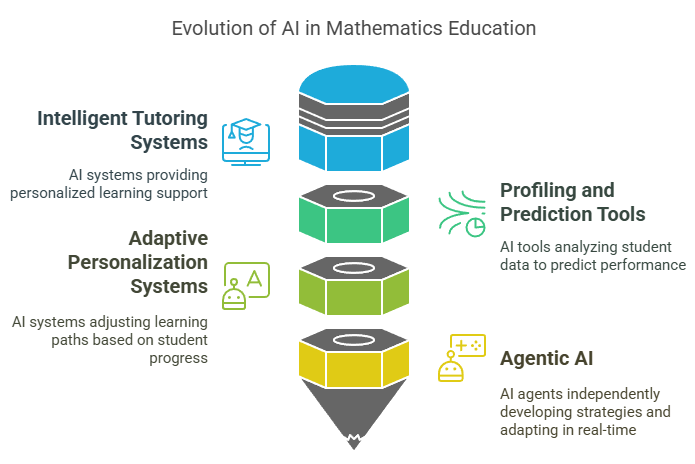
The evolution of AI in education has progressed through several stages, from simple rule-based systems to today’s adaptive, autonomous agents. As Hwang and Tu (2021) note in their comprehensive review, AI in mathematics education has historically been deployed primarily as intelligent tutoring systems (45.24% of applications), followed by profiling and prediction tools (28.57%) and adaptive personalization systems (21.43%) [MDPI Mathematics].
The transition to agentic AI represents a significant advancement from these earlier implementations. While traditional AI systems require explicit prompting to generate results and follow predetermined pathways, agentic AI can develop strategies independently, execute actions, and adapt in real-time based on student performance. This shift enables more dynamic and responsive educational experiences that can evolve alongside student understanding.
2. Theoretical Foundations and Models
2.1 Pedagogical Frameworks Supporting AI in Mathematics Education
Several pedagogical frameworks provide the foundation for implementing agentic AI in mathematics education:
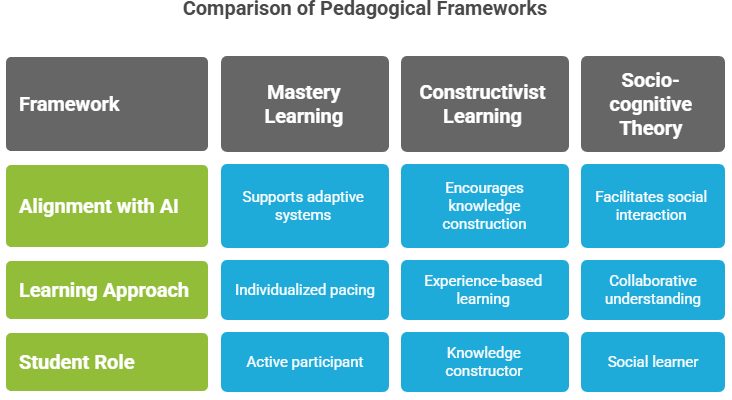
Mastery Learning Mastery learning, which emphasizes that students should achieve a high level of understanding before advancing to new concepts, aligns well with AI-powered adaptive systems. These systems can provide the repeated practice, immediate feedback, and individualized pacing that mastery learning requires [Hundred.org].
Constructivist Learning Theory Constructivist approaches emphasize that learners actively construct knowledge through experience and reflection. AI systems that encourage students to teach mathematical concepts to AI agents (as seen in teachable agent models) build on this framework by positioning students as knowledge constructors rather than passive recipients [attheU].
Socio-cognitive Theory This theory emphasizes that learning occurs within social contexts. Agentic AI systems that simulate social interactions, such as those employing AI teachable agents that function as peers, draw on socio-cognitive principles by creating opportunities for students to articulate their mathematical understanding within a social, collaborative framework [Link Springer].
2.2 Mathematical Knowledge Representation in AI Systems
Effective agentic AI systems in mathematics education depend on sophisticated knowledge representation. Examples include:
Knowledge Graphs and Atomic Elements Squirrel AI’s approach involves breaking down mathematics into thousands of “knowledge points.” For middle school mathematics alone, their system identifies over 10,000 discrete concepts, creating a highly granular representation of the subject matter. These knowledge points form an interconnected graph that maps relationships between concepts, allowing the AI to track a student’s progress across the conceptual landscape [MIT Technology Review].
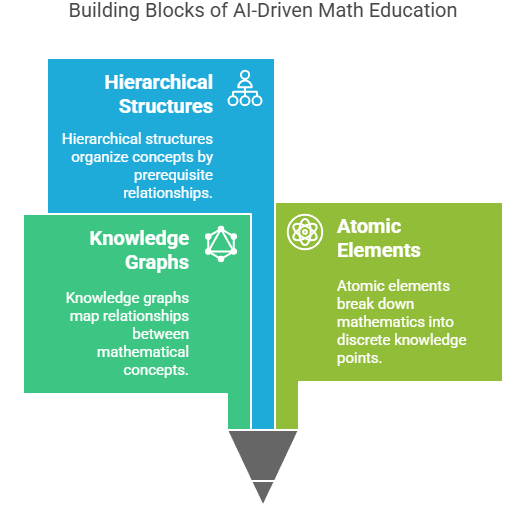
Hierarchical and Prerequisite Structures Many AI systems employ hierarchical structures that organize mathematical concepts according to prerequisite relationships. For instance, Carnegie Learning’s MATHia uses a framework that considers both horizontal connections (related concepts) and vertical progressions (prerequisites) to ensure that students master foundational knowledge before advancing to more complex ideas [EduSoft].
3. Current Applications and Case Studies
3.1 Adaptive Learning Systems and Intelligent Tutoring
MATHia by Carnegie Learning MATHia uses AI to provide hyper-individualized support for mathematics learning. The system adapts to each student’s learning style and needs, offering personalized instruction and feedback. While specific details about its results aren’t available in the crawled content, it is notable for its approach to mathematics education that goes beyond simply marking answers as right or wrong, focusing instead on understanding student thinking processes [Carnegie Learning].
Squirrel AI Squirrel AI’s approach to mathematics learning involves breaking down subjects into extremely granular “knowledge points” (over 10,000 for middle school math). The system begins with a diagnostic test to assess student understanding and then uses machine learning to create a personalized curriculum that continuously adapts based on performance. A study with 78 middle school students found that the system was more effective at improving math test scores than traditional classroom teaching by experienced teachers. Individual case studies show significant improvements, such as a student named Zhou Yi, who improved from 50% to 85% over two years at MIT Technology Review.
Rori AI Tutor Rori is a chat-based AI math tutor designed for use via WhatsApp. A study conducted in Ghana with 1,000 students in grades 3-9 across 11 schools demonstrated that students who received two 30-minute sessions with Rori per week over 8 months, in addition to their regular math lessons, achieved “markedly higher scores” with an effect size of 0.36. This suggests that AI-powered tutoring can be effectively deployed in resource-constrained environments to improve mathematics learning outcomes Rising Academies.
3.2 Teachable Agent Systems
ALTER-Math Developed by researchers at the University of Utah, ALTER-Math employs a “learning by teaching” approach where students teach mathematics to an AI agent that is intentionally designed to make mistakes. This system shifts students from passive learners to active teachers, engaging them in guiding a fictional AI peer through algebra problems embedded in real-world contexts. Since its October 2023 launch, ALTER-Math has been used by over 50,000 middle school students, with data showing that users experience a 1.56 times increase in learning gains compared to traditional approaches [attheU].
Math Nation with Teachable Agents The University of Florida’s ALTER-Math initiative integrates AI-powered teachable agents into Math Nation, a core curriculum used by over one million students annually. The project, led by associate professor Wanli Xing, leverages UF’s HiPerGator supercomputer to develop agents that allow students to learn mathematics by teaching it to AI peers [Forward Pathway].
3.3 Communicative AI Agents in Mathematical Task Design
A study by Schorcht, Peters, and Kriegel (2025) explored the use of communicative AI agents in designing mathematical tasks. The research employed a network of four specialized AI agents that collaborated to evaluate and modify mathematical tasks spanning from basic arithmetic to complex problem-solving. While the AI-modified tasks successfully incorporated additional solution approaches and enriched task content, the study identified challenges in balancing detailed explanations with the concise formulation required for effective tasks. Teacher evaluations suggested that with proper oversight, such systems could support the development of more creative and individualized learning materials [Springer].
3.4 Large Language Models as Mathematics Tutors
Recent research has also investigated the effectiveness of large language models such as GPT-4 as mathematics tutors. A study by the University of Pennsylvania examined the impact of GPT-4-powered tutors on high school students’ mathematics performance. While students using the AI tutors performed significantly better on practice exams (with improvements of 48% for basic GPT and 127% for the advanced GPT Tutor), these gains did not translate to improved performance on actual tests. In fact, students who used the basic GPT tutor scored 17% worse on the final exam than the control group, while those using the more advanced tutor performed on par with the control group. This suggests that students may have been using the AI as an “answer machine” rather than as a tool to develop deeper understanding [Tech Learning].
4. Benefits and Effectiveness
4.1 Personalization and Adaptive Learning
Agentic AI systems offer significant advantages in personalizing mathematics education:
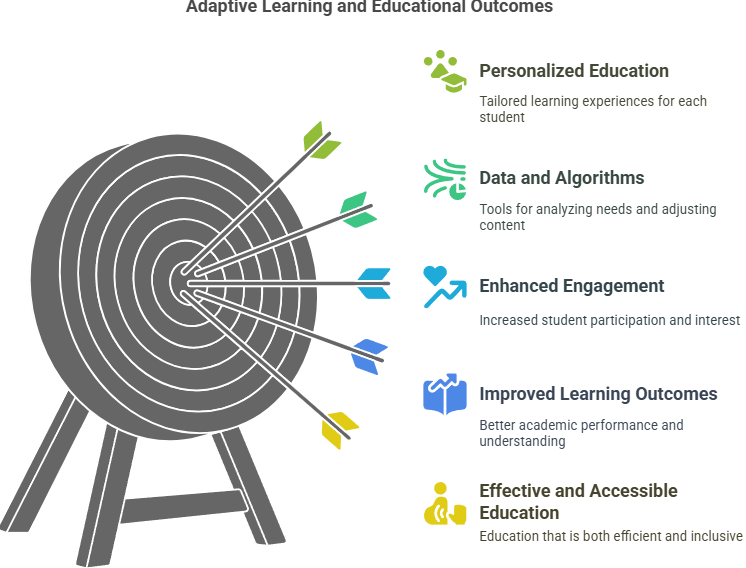
Individualized Learning Paths By analyzing student performance data, agentic AI can create customized learning pathways that address specific strengths and weaknesses. For example, Squirrel AI’s system conducts initial diagnostic assessments to identify knowledge gaps and then tailors instruction accordingly, adapting in real-time as students progress [MIT Technology Review].
Real-time Adaptation Unlike static curricula, agentic AI systems continuously update content delivery based on immediate performance. This enables them to provide the right level of challenge at the right time, avoiding both frustration from material that is too difficult and disengagement from content that is too simple [Mayfly Ventures].
Addressing Diverse Learning Needs Research suggests that AI-powered mathematics education can be particularly beneficial for students with diverse learning needs. By accommodating different learning speeds, styles, and preferences, these systems can help bridge achievement gaps and provide equitable access to quality mathematics instruction [EduSoft].
4.2 Impact on Student Engagement and Motivation
Reduction in Mathematics Anxiety A recent survey found that 56% of high school students reported that AI tools helped reduce the anxiety they felt about studying mathematics. Students cited the availability of instant help and clarification as key factors in this anxiety reduction [Medium].
Increased Agency Through Teachable Agents Systems that position students as teachers to AI agents, such as ALTER-Math, may enhance engagement by giving students a sense of agency and responsibility. When students guide their own AI peer through solving problems, they become more actively involved in the learning process [attheU].
Real-world Contextual Learning Many agentic AI systems embed mathematical concepts in real-world contexts, making abstract ideas more concrete and relevant. This contextual approach can boost motivation by helping students understand the practical applications of the mathematics they are learning [Forward Pathway].
4.3 Evidence of Effectiveness from Research Studies
Several research studies provide evidence for the effectiveness of agentic AI in mathematics education:
Rori AI Tutor in Ghana A study involving 1,000 students across 11 schools in Ghana found that those who received additional instruction via the Rori AI tutor showed significantly improved mathematics scores, with an effect size of 0.36. This suggests that AI-powered tutoring can be effective even in resource-constrained environments [Rising Academies].
ALTER-Math Learning Gains Data from the ALTER-Math project indicated that students using the AI teachable agent system experienced learning gains 1.56 times greater than those using traditional approaches. With over 50,000 middle school students having used the system, these results suggest considerable promise for the learning-by-teaching approach [attheU].
Meta-Analysis of Intelligent Tutoring Systems A meta-analysis by Steenbergen-Hu and Cooper (2013) examining the effectiveness of intelligent tutoring systems on K-12 students’ mathematical learning found modest positive effects overall, suggesting that these systems can be valuable supplements to traditional instruction [PsycNet].
5. Challenges and Limitations
5.1 Technical Challenges
Balancing Precision with Comprehension A study on communicative AI agents in mathematical task design highlighted the difficulty in achieving the right balance between detailed explanations and concise, precise formulations. While AI systems could generate enriched content, they sometimes struggled to maintain the clarity needed for effective mathematical tasks [Springer].
AI Hallucinations and Mathematical Accuracy The potential for AI hallucinations—generating plausible but incorrect information—poses particular challenges in mathematics education where precision is essential. Research has shown that even advanced systems like GPT-4 can make errors in mathematical reasoning, highlighting the need for careful validation of AI-generated content [Link Springer].
Integration with Existing Educational Systems Implementing agentic AI in mathematics education often requires significant technical infrastructure and integration with existing learning management systems. This can present barriers to adoption, particularly in under-resourced educational settings [DigitalDefynd].
5.2 Pedagogical Concerns
Over-reliance on Technology Research indicates that students may become overly dependent on AI tutors, using them as “answer machines” rather than tools for developing deeper understanding. A University of Pennsylvania study found that while students using GPT-4 tutors performed better on practice exams with AI assistance, they did not show improved performance on actual tests taken without AI support [Tech Learning].
Balancing Procedural Fluency with Conceptual Understanding, AI systems may excel at guiding students through procedural mathematics but may be less effective at fostering the deep conceptual understanding that is essential for mathematical thinking. This highlights the need for AI tools that encourage exploration, reasoning, and problem-solving rather than just providing correct answers [International Journal of Pedagogical Research].
Limited Emotional and Social Components Mathematics learning involves not only cognitive but also emotional and social dimensions that current AI systems may struggle to address adequately. While some advances have been made in developing emotionally intelligent AI, these aspects of learning still present significant challenges for fully automated systems [MeraTutor.AI].
5.3 Ethical Considerations
Data Privacy and Security The collection and use of student data in AI-powered mathematics education raises important privacy concerns. As these systems track detailed information about student performance and learning behaviors, ensuring appropriate data protection becomes increasingly critical [Journal of Pedagogical Research].
Algorithmic Bias and Equity There is a risk that AI systems may perpetuate or amplify existing biases in mathematics education. If the data used to train these systems reflects historical inequities or if the algorithms themselves contain biases, this could disadvantage certain groups of students [International Journal of Pedagogical Research].
Teacher-Student Relationship The introduction of agentic AI into mathematics classrooms raises questions about the changing role of teachers and the potential impact on the teacher-student relationship. While AI can enhance certain aspects of instruction, the human connection in education remains vital, particularly for motivational and emotional support [Forward Pathway].
6. Implementation Strategies
6.1 Integration into Curriculum
Blended Learning Approaches Successful implementation of agentic AI in mathematics education often involves blended learning models that combine AI-powered instruction with traditional teaching. For example, the Rori AI tutor was used as a supplement to regular mathematics lessons rather than a replacement, with students receiving two 30-minute AI tutoring sessions per week in addition to their standard curriculum [Rising Academies].
Curriculum Alignment Ensuring that AI systems align with established mathematics curriculum standards is essential for meaningful integration. Florida Virtual School’s AI in Math certification program, developed in partnership with the University of Florida and the Concord Consortium, exemplifies this approach by introducing AI principles within the context of core mathematics topics [eSchool News].
Staged Implementation A phased approach to implementation allows for gradual integration and evaluation. Starting with pilot programs focused on specific mathematical topics or grade levels can help identify best practices before broader deployment [GovTech].
6.2 Teacher Professional Development
AI Literacy for Mathematics Educators Effective use of agentic AI in mathematics classrooms requires teachers to develop AI literacy and an understanding of how these tools can support their pedagogical goals. Professional development programs focusing on both technical skills and pedagogical integration are essential [Forward Pathway].
Collaborative Design Involving mathematics teachers in the design and refinement of AI tools can enhance their relevance and effectiveness. The study on communicative AI agents in mathematical task design highlighted the importance of teacher evaluation and input in ensuring that AI-generated content meets educational needs [Springer].
Redefining Teacher Roles As agentic AI takes on certain aspects of mathematics instruction, teacher roles may evolve toward facilitation, mentorship, and providing the human connection that AI cannot replicate. Professional development should prepare teachers for these shifting responsibilities [MeraTutor.AI].
6.3 Assessment and Evaluation Strategies
Beyond Answer-Based Assessment With AI systems increasingly able to solve mathematics problems, assessment strategies need to evolve beyond simple answer-based evaluation. Focusing on process, reasoning, and application may provide better measures of student understanding in an AI-enhanced learning environment [Tech Learning].
Continuous Formative Assessment Agentic AI systems excel at collecting detailed data on student performance, enabling continuous formative assessment. Leveraging this capability can provide teachers with rich insights into student progress and needs, allowing for more targeted interventions [Mayfly Ventures].
Evaluating AI System Effectiveness Regular evaluation of the effectiveness of AI systems themselves is crucial for ongoing improvement. This requires clear metrics for success that go beyond short-term performance gains to consider long-term mathematical understanding and engagement [Rising Academies].
7. Future Trends and Research Directions
7.1 Emerging Technologies and Approaches
Multimodal Learning Experiences Future agentic AI systems for mathematics education are likely to incorporate multiple modalities, combining text, visual, auditory, and interactive elements to create richer learning experiences. Integration with augmented reality (AR) and virtual reality (VR) could enable more immersive exploration of mathematical concepts [MeraTutor.AI].
Collaborative AI Agents Research is increasingly focusing on collaborative AI agents that can work together as a team to support mathematics learning. The study on communicative AI agents in mathematical task design demonstrated the potential of a network of specialized agents with different expertise working collaboratively [Springer].
Enhanced Emotional Intelligence Future developments in agentic AI for mathematics education will likely place greater emphasis on emotional intelligence, with systems designed to detect and respond appropriately to student emotions such as frustration, confusion, or anxiety [MeraTutor.AI].
7.2 Expanding Application Domains
Advanced Mathematics Topics Current applications of agentic AI in mathematics education have focused primarily on elementary and middle school mathematics, particularly discrete mathematics and algebra. Future research should expand to include more advanced topics such as geometry, topology, applied mathematics, and cross-disciplinary STEM courses [MDPI Mathematics].
Mathematics Teacher Education Agentic AI systems could also be developed to support mathematics teacher education, helping pre-service and in-service teachers enhance their content knowledge and pedagogical skills [MDPI Mathematics].
Cross-cultural Mathematics Learning Research into how agentic AI can be adapted to support mathematics learning across different cultural contexts represents an important frontier, particularly given the global relevance of mathematical skills and the varied approaches to teaching mathematics worldwide [Rising Academies].
7.3 Research Priorities
Long-term Impact Studies While initial research has shown promising short-term results, longitudinal studies examining the long-term impact of agentic AI on mathematics learning outcomes and attitudes toward mathematics are needed [Tech Learning].
Integration of Modern AI Techniques Further research should explore the integration of cutting-edge AI technologies, including deep learning approaches, within mathematics education. This could lead to more sophisticated systems capable of more nuanced understanding and support [MDPI Mathematics].
Cognitive Load and Learning Processes Investigating how agentic AI affects cognitive load and learning processes in mathematics education represents another important research direction. Understanding these mechanisms could lead to more effective design of AI-enhanced learning environments [MDPI Mathematics].
8. Conclusion
Agentic AI is poised to significantly transform mathematics teaching and learning through its capacity for autonomous decision-making, personalization, and adaptive support. Current implementations across various contexts—from Squirrel AI’s granular knowledge mapping to ALTER-Math’s teachable agents—demonstrate both the potential and the complexities of integrating these technologies into mathematics education.
The research reviewed in this report suggests that when thoughtfully implemented, agentic AI can enhance mathematics learning outcomes, increase engagement, and potentially reduce mathematics anxiety. Systems that position students as active participants rather than passive recipients appear particularly promising, highlighting the importance of designing AI tools that support agency and deep learning rather than simply providing answers.
However, significant challenges remain. Technical issues around accuracy and integration, pedagogical concerns about over-reliance on technology, and ethical considerations regarding data privacy and equity all require careful attention. Moreover, the mixed results from some studies, such as the limited transfer of learning observed with GPT-4 tutors, underscore the need for continued research into effective implementation strategies.
As agentic AI continues to evolve, its role in mathematics education will likely expand beyond current applications to encompass more advanced topics and diverse learning contexts. The most successful approaches will likely be those that thoughtfully blend technological capabilities with sound pedagogical principles, maintaining the essential human elements of teaching while leveraging AI’s unique strengths to create more personalized, engaging, and effective mathematics learning experiences.
In the end, the goal should not be to replace human teachers but to augment and transform mathematics education in ways that help all students develop both procedural fluency and conceptual understanding, preparing them for a future where mathematical literacy will be increasingly essential.
References
- Datacamp – Agentic AI: How It Works, Benefits, Comparison With Traditional AI
- MeraTutor.AI – Agentic AI in Education: Revolutionizing Learning
- MDPI Mathematics – Roles and Research Trends of Artificial Intelligence in Mathematics Education
- Springer – Communicative AI Agents in Mathematical Task Design
- EduSoft – Agentic AI in STEM Education: Enhancing Cognitive Flexibility and Workforce Readiness
- MIT Technology Review – China has started a grand experiment in AI education
- attheU – AI paves the way for kids to learn math by teaching it
- Tech Learning – High School Math Students Used A GPT-4 AI Tutor. They did Worse
- Rising Academies – Oxford and J-PAL Researchers see strong early results for Rising’s AI tutor
- Forward Pathway – AI-Powered Math Education: Innovation, Challenges, and Future Prospects
- International Journal of Pedagogical Research – Artificial intelligence in mathematics education: The good, the bad, and the ugly
- Mayfly Ventures – AI Agents in Education: Personalized Learning and Tutoring
- Medium – Beyond the Algorithm: How Artificial Intelligence is Easing Math Anxiety
- eSchool News – Florida Virtual School Partners with University of Florida and Concord Consortium
- PsycNet – A meta-analysis of the effectiveness of intelligent tutoring systems on K–12 students’ mathematical learning
- DigitalDefynd – 20 Pros & Cons of Agentic AI
- Hundred.org – Streamlined Success: Leveraging AI for Multi-Level Math Mastery
- GovTech – Florida Virtual School to Offer AI in Math Certificate

